Muscle Weakness After Stroke: How Rehabilitation Supports Recovery – ADP Physiotherapy
Introduction
A stroke can significantly affect a person’s ability to move, walk, maintain balance, and perform everyday activities. One of the most common challenges experienced by stroke survivors is muscle weakness, which may affect the arms, legs, hands, or one side of the body. This weakness can make simple activities such as standing, holding objects, dressing, and walking more difficult.
Post Stroke Muscle Rehabilitation plays an important role in helping stroke survivors regain movement, improve muscle control, and become more independent in daily life. Through personalized physiotherapy, strengthening exercises, balance training, and functional movement activities, rehabilitation can help patients work toward their recovery goals.
At ADP Physiotherapy in Kalyan East, patients can seek professional physiotherapy support for muscle weakness after stroke, walking difficulties, balance problems, and reduced mobility. Individualized rehabilitation programs focus on improving functional strength, coordination, and movement to support recovery and greater independence.
In this article, we explain the causes and symptoms of muscle weakness after stroke, the importance of Post Stroke Muscle Rehabilitation, effective physiotherapy techniques, recovery timelines, and how structured rehabilitation supports mobility and daily functioning.
What Causes Muscle Weakness After Stroke?
A stroke occurs when blood flow to part of the brain is blocked or when bleeding occurs within the brain. This can damage brain tissue responsible for controlling movement, coordination, and other functions.
When areas of the brain involved in motor control are affected, communication between the brain and muscles may become impaired.
As a result, patients may experience reduced muscle strength, difficulty initiating movement, poor coordination, or changes in muscle tone.
Muscle weakness after stroke is often referred to as hemiparesis when it affects one side of the body. More severe loss of movement may be described as hemiplegia.
The degree of weakness depends on factors such as the location and severity of the stroke, the patient’s overall health, and the stage of recovery.
Although recovery varies from person to person, appropriate rehabilitation can help patients develop or regain functional abilities.
Common Symptoms of Muscle Weakness After Stroke
Muscle weakness may appear alongside several other movement-related difficulties.
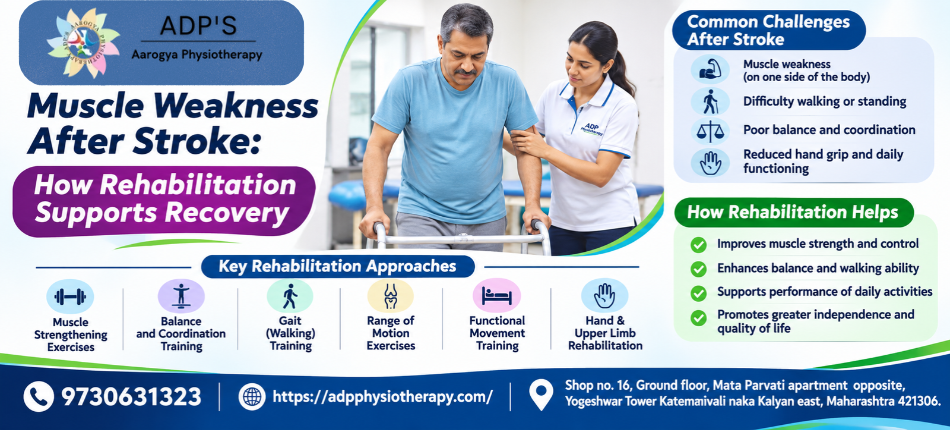
1. Weakness on One Side of the Body
Many stroke survivors experience weakness in one arm, one leg, or both on the same side of the body.
This may affect walking, standing, lifting objects, and everyday movements.
2. Difficulty Walking or Standing
Reduced leg strength, impaired balance, and poor coordination may make walking difficult.
Some patients may need assistance, walking aids, or supervised gait training during rehabilitation.
3. Reduced Hand Grip Strength
Weakness in the hand and fingers may make it difficult to hold utensils, button clothes, write, or perform other fine motor activities.
4. Poor Balance and Coordination
Stroke can affect the brain’s ability to coordinate movement and maintain postural stability.
This may increase the risk of falls, especially during standing, turning, and walking.
5. Muscle Stiffness or Spasticity
Some patients develop increased muscle tone or involuntary muscle contractions after stroke.
Spasticity can make movements uncomfortable or difficult and may interfere with daily activities.
6. Difficulty Performing Daily Activities
Tasks such as bathing, dressing, eating, climbing stairs, and getting out of bed may become challenging.
7. Fatigue During Physical Activity
Post-stroke fatigue is common and can affect participation in rehabilitation and daily routines.
Fatigue may occur even when the physical activity seems relatively simple.
Why Is Post Stroke Muscle Rehabilitation Important?
Post Stroke Muscle Rehabilitation focuses on improving movement, functional strength, balance, coordination, and independence after a stroke.
A stroke can disrupt the brain’s ability to control muscles effectively. Rehabilitation helps patients practice meaningful movements and develop strategies to perform daily tasks more safely.
An important principle behind stroke rehabilitation is neuroplasticity, which refers to the brain’s ability to adapt and reorganize neural connections through learning and experience.
Repeated, task-specific practice can support motor learning and functional recovery.
Rehabilitation also helps address secondary complications such as reduced physical fitness, joint stiffness, muscle shortening, and inactivity-related weakness.
While physiotherapy cannot guarantee complete recovery, a structured and individualized program can help many stroke survivors improve their mobility and quality of life.
How Physiotherapy Helps Improve Muscle Weakness After Stroke
Physiotherapy is an important part of multidisciplinary stroke rehabilitation.
A physiotherapist evaluates movement limitations and develops a treatment plan based on the patient’s abilities, medical stability, and rehabilitation goals.
1. Muscle Strengthening Exercises
Strengthening exercises help improve the ability of weakened muscles to generate force.
Exercises may target the arms, legs, trunk, and other muscle groups needed for functional activities.
Resistance bands, light weights, body-weight exercises, or supported movements may be used according to the patient’s condition.
Strengthening programs should be progressive and adapted to the patient’s movement control, fatigue levels, and safety needs.
2. Balance and Coordination Training
Balance exercises help patients improve stability while sitting, standing, and moving.
Training may include controlled weight shifting, supported standing, reaching activities, and supervised balance challenges.
Improved balance can help patients perform daily activities more confidently and reduce certain fall risks.
3. Gait Training for Walking Recovery
Walking difficulties are common after stroke.
Gait training focuses on improving walking patterns, weight transfer, step control, and mobility.
A physiotherapist may use parallel bars, walking aids, treadmills, or other appropriate equipment depending on the patient’s needs.
Some patients may benefit from ankle-foot orthoses or other assistive devices following professional assessment.
4. Range of Motion Exercises
Range of motion exercises help maintain or improve joint mobility.
These may include active movements performed by the patient or assisted movements when muscle control is limited.
Appropriate positioning and movement techniques are particularly important for protecting a weak shoulder after stroke.
5. Functional Movement Training
Functional Movement Training is an important part of Post Stroke Muscle Rehabilitation, as it focuses on helping stroke survivors regain the ability to perform everyday activities safely and independently. After a stroke, muscle weakness, poor coordination, reduced balance, and limited mobility can make simple tasks such as getting out of bed, standing from a chair, walking, reaching for objects, or climbing stairs difficult. Functional movement training involves practicing these daily activities through structured, repetitive, and task-specific exercises under the guidance of a qualified physiotherapist. By repeatedly performing meaningful movements, patients can improve muscle activation, coordination, balance, and movement control while supporting the brain’s ability to adapt through neuroplasticity. Physiotherapists may incorporate activities such as sit-to-stand exercises, bed mobility training, supported walking, reaching and grasping exercises, and safe transfer techniques based on the patient’s physical abilities and recovery stage. As patients progress, the difficulty of these activities may be gradually increased to improve functional strength, confidence, and independence. At ADP Physiotherapy in Kalyan East, individualized rehabilitation approaches can help stroke survivors work toward improved mobility and greater participation in daily activities. Although recovery outcomes vary, consistent functional movement training can contribute to meaningful improvements in physical function and quality of life.
6. Neuromuscular Electrical Stimulation
In selected patients, neuromuscular electrical stimulation or functional electrical stimulation may be used as part of a supervised rehabilitation program.
Electrical stimulation can help activate certain muscles and may support specific movement goals.
Its suitability depends on the patient’s condition, treatment objectives, and clinical assessment.
7. Upper Limb and Hand Rehabilitation
Weakness in the arm and hand can make everyday tasks particularly difficult.
Upper limb rehabilitation may involve repetitive reaching, grasping, releasing, and object manipulation activities.
Some patients may benefit from approaches such as mirror therapy or constraint-induced movement therapy when clinically appropriate.
Occupational therapy may also be important for improving hand function and daily living skills.
Post Stroke Muscle Rehabilitation Exercises
Exercise selection depends on the patient’s abilities, medical condition, and stage of recovery.
The following are examples of activities that may be included in a supervised rehabilitation program.
1. Assisted Arm Movements
Assisted movements may help patients practice shoulder, elbow, and wrist control when independent movement is limited.
Care must be taken to avoid pulling or placing excessive stress on the affected shoulder.
2. Seated Knee Extension
While sitting securely, the patient may practice slowly straightening one knee and lowering the leg.
This activity may help improve quadriceps activation and lower-limb control.
3. Supported Sit-to-Stand Training
Practicing standing up from a stable chair can help strengthen the legs and improve functional mobility.
Patients with poor balance or significant weakness may require supervision or physical assistance.
4. Supported Weight Shifting
Under supervision, patients may practice transferring weight from one leg to the other while holding a stable support.
This can help develop standing balance and prepare for walking activities.
5. Hand Opening and Grasping Activities
Reaching for and handling suitable objects may help patients practice hand and finger movements.
The activity should match the patient’s current ability and avoid painful or forced movement.
6. Supervised Walking Practice
Walking practice may be included when the patient is medically stable and able to participate safely.
The therapist may adjust the walking distance, level of assistance, and equipment based on progress.
Important: Stroke survivors should not begin challenging balance, standing, or walking exercises without appropriate assessment. Exercise programs must be individualized to reduce the risk of falls, shoulder injury, and overexertion.
How Long Does Muscle Recovery Take After Stroke?
The duration of muscle recovery after stroke varies from person to person and depends on several factors, including the severity of the stroke, the location of brain injury, the extent of muscle weakness, age, overall health, and access to appropriate rehabilitation. Many stroke survivors experience noticeable improvements in muscle strength, movement, and coordination during the first three to six months after a stroke, when neurological recovery is often most rapid. However, recovery does not necessarily stop after this period. With consistent Post Stroke Muscle Rehabilitation, patients may continue making functional improvements months or even years after the initial stroke. Physiotherapy techniques such as muscle strengthening exercises, gait training, balance exercises, functional movement training, and repetitive task practice can help patients improve mobility and perform daily activities more effectively. Some individuals may regain substantial muscle strength and independence, while others may continue to experience weakness or require assistive devices and ongoing rehabilitation. Early assessment, personalized physiotherapy, regular exercise, and family support can positively influence rehabilitation progress. At ADP Physiotherapy in Kalyan East, patients can seek guidance on individualized stroke rehabilitation programs designed to support movement, balance, muscle control, and functional independence. It is important to understand that stroke recovery is a gradual process, and rehabilitation goals should be based on each patient’s condition rather than a fixed recovery timeline.
Can Muscle Strength Return to Normal After Stroke?
Some stroke survivors regain substantial strength and movement, while others continue to experience lasting limitations.
The possibility of recovery depends on the extent of neurological injury and the individual’s response to rehabilitation.
Physiotherapy can help improve functional strength, movement efficiency, balance, and mobility.
However, rehabilitation does not guarantee that muscle strength or movement will return completely to pre-stroke levels.
For many patients, meaningful recovery also involves learning safer ways to perform everyday activities and using assistive devices when needed.
The Role of Neuroplasticity in Stroke Recovery
Neuroplasticity is the brain’s ability to change and adapt in response to learning, experience, and repeated activity.
After stroke, surviving neural networks may adapt to support certain functions affected by brain injury.
Rehabilitation programs use repeated, purposeful movements to encourage motor learning.
For example, practicing reaching, standing, and walking under appropriate supervision can help patients improve coordination and functional performance.
Consistency, suitable exercise intensity, and meaningful task practice are important components of rehabilitation.
The amount and type of training should be tailored to the patient’s medical condition and tolerance.
How to Improve Walking and Balance After Stroke
Walking recovery often requires more than muscle strengthening alone.
Stroke may affect coordination, sensation, balance, joint control, and the ability to transfer weight between the legs.
A physiotherapist may assess walking speed, step length, balance, muscle activation, and the need for assistive devices.
Treatment may involve supported standing, gait training, strengthening, balance exercises, and functional movement practice.
Some patients may require an ankle-foot orthosis to improve foot clearance or stability.
The rehabilitation plan should focus on safe mobility and realistic functional goals rather than walking distance alone.
How Rehabilitation Helps Prevent Complications After Stroke
Reduced mobility after stroke can increase the risk of secondary health problems.
Appropriate rehabilitation and medical care can help address complications such as joint stiffness, muscle shortening, reduced endurance, and physical deconditioning.
Positioning, movement practice, and appropriate exercise may help maintain mobility and comfort.
Patients with significant weakness may also require pressure injury prevention, safe transfer techniques, and assistance with daily activities.
Stroke rehabilitation should be coordinated with the treating medical team, particularly when patients have additional medical conditions.
When Should Stroke Rehabilitation Begin?
Stroke rehabilitation often begins as soon as the patient is medically stable and the treating stroke team determines that activity is safe.
Early rehabilitation may include positioning, gentle movement, sitting balance, and carefully supervised mobility activities.
However, intensive mobilization very early after stroke is not appropriate for every patient.
The timing, intensity, and progression of therapy depend on the type and severity of stroke, cardiovascular stability, neurological symptoms, and overall medical condition.
A rehabilitation professional should determine the safest starting point.
Importance of Family Support During Stroke Recovery
Family members and caregivers often play an important role in supporting rehabilitation.
They can help patients follow prescribed exercise routines, attend appointments, and practice safe daily activities.
Encouragement and realistic goal-setting may improve participation in rehabilitation.
Caregivers should also learn safe assistance techniques to reduce the risk of falls or injury.
Emotional support is important because stroke survivors may experience frustration, anxiety, depression, or changes in confidence.
Professional guidance can help families understand expected challenges and adapt their support as recovery progresses.
When Should You Consult a Physiotherapist After Stroke?
A physiotherapy assessment is recommended when a stroke survivor experiences ongoing muscle weakness, difficulty walking, poor balance, reduced coordination, or limitations in daily activities.
Patients who struggle to stand, transfer between surfaces, use their affected arm, or perform basic movements may benefit from a structured rehabilitation program.
A physiotherapist can assess muscle strength, joint movement, balance, gait, and functional limitations before recommending suitable exercises and treatment strategies.
Rehabilitation may also be beneficial for individuals who experienced a stroke months or years earlier and continue to have mobility difficulties.
Emergency Warning: If someone develops sudden new weakness, facial drooping, speech difficulty, vision changes, or other possible stroke symptoms, seek emergency medical care immediately. Do not wait for a physiotherapy appointment.
Stroke Physiotherapy and Rehabilitation in Kalyan East – ADP Physiotherapy
If you or a family member is experiencing muscle weakness after stroke, difficulty walking, balance problems, or reduced mobility, professional physiotherapy assessment can help identify suitable rehabilitation goals.
At ADP Physiotherapy in Kalyan East, patients can enquire about physiotherapy services for mobility limitations, muscle weakness, and rehabilitation needs.
A rehabilitation plan may include strengthening exercises, balance training, gait rehabilitation, functional movement practice, and patient education, depending on the individual’s condition and clinical assessment.
The aim is to support safer movement, improved physical function, and greater independence in everyday activities.
Conclusion
Muscle weakness after stroke can affect walking, balance, hand movements, and independence in daily activities. Although recovery varies between individuals, appropriate rehabilitation can play an important role in improving movement and functional ability.
Post Stroke Muscle Rehabilitation combines strengthening, balance training, gait rehabilitation, functional activities, and individualized exercise programs to help patients work toward meaningful recovery goals.
Early medical assessment, consistent rehabilitation, caregiver involvement, and realistic expectations are important for long-term progress.
If you are searching for stroke physiotherapy in Kalyan East, contact ADP Physiotherapy to discuss your rehabilitation needs.
Call: +91 97306 31323
Website: https://adpphysiotherapy.com/
Post Stroke Muscle Rehabilitation Post Stroke Muscle Rehabilitation Post Stroke Muscle Rehabilitation Post Stroke Muscle Rehabilitation Post Stroke Muscle Rehabilitation Post Stroke Muscle Rehabilitation Post Stroke Muscle Rehabilitation Post Stroke Muscle Rehabilitation Post Stroke Muscle Rehabilitation Post Stroke Muscle Rehabilitation Post Stroke Muscle Rehabilitation Post Stroke Muscle Rehabilitation Post Stroke Muscle Rehabilitation Post Stroke Muscle Rehabilitation Post Stroke Muscle Rehabilitation Post Stroke Muscle Rehabilitation Post Stroke Muscle Rehabilitation Post Stroke Muscle Rehabilitation Post Stroke Muscle Rehabilitation Post Stroke Muscle Rehabilitation Post Stroke Muscle Rehabilitation Post Stroke Muscle Rehabilitation Post Stroke Muscle Rehabilitation Post Stroke Muscle Rehabilitation