
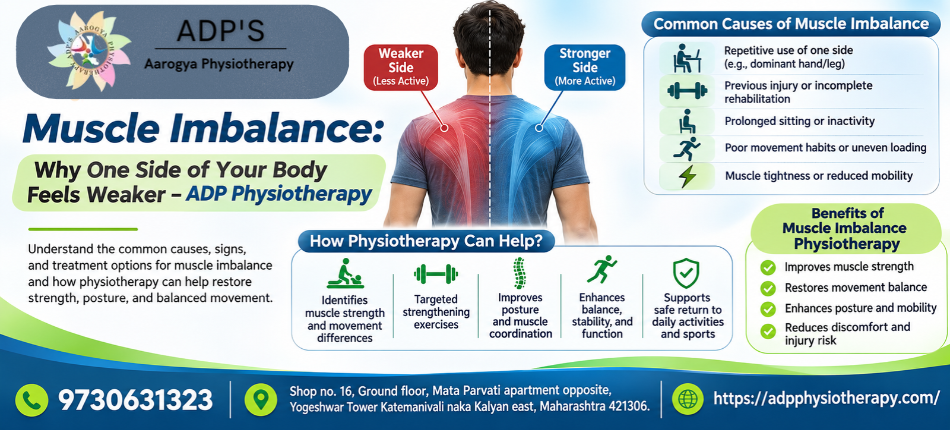
Muscle Imbalance: Why One Side of Your Body Feels Weaker – ADP Physiotherapy
Introduction
Have you ever noticed that one arm feels stronger than the other, one shoulder sits slightly higher, or one leg gets tired faster during walking or exercise? These differences may sometimes indicate a muscle imbalance, a condition in which certain muscles or muscle groups have different levels of strength, flexibility, endurance, or coordination. Muscle imbalances can develop gradually due to repetitive movements, prolonged sitting, previous injuries, reduced physical activity, or uneven loading during daily activities. Although minor differences between the left and right sides of the body are normal, significant imbalances may contribute to muscle weakness, discomfort, reduced mobility, and difficulty performing everyday activities. Muscle Imbalance Physiotherapy focuses on identifying relevant strength differences and improving muscle function through targeted strengthening exercises, mobility training, balance exercises, and rehabilitation. At ADP Physiotherapy in Kalyan East, patients experiencing muscle weakness, posture-related discomfort, movement difficulties, or recovery challenges following an injury can seek professional physiotherapy assessment and personalized rehabilitation guidance. In this comprehensive guide, we explore the common causes of muscle imbalance, why one side of your body may feel weaker, important symptoms, physiotherapy treatment approaches, corrective exercises, and practical tips for maintaining better muscle strength, coordination, and overall physical function.
1. What Is Muscle Imbalance?
Muscle imbalance refers to a difference in strength, flexibility, endurance, or coordination between muscles that work together or between corresponding muscle groups on opposite sides of the body. Muscles normally function in coordinated patterns to support posture, stabilize joints, and produce movement. However, when certain muscles become relatively weaker, tighter, or less active than others, movement patterns may change and some activities may become less efficient or comfortable. For example, a person may notice that one leg feels less stable during climbing stairs, one shoulder becomes fatigued while carrying objects, or one side of the body performs differently during exercise. Not every difference indicates a medical problem, because natural side-to-side variation is common. However, persistent weakness, pain, reduced mobility, or difficulty performing everyday activities may require assessment. Muscle Imbalance Physiotherapy involves evaluating these differences and developing an individualized rehabilitation program to improve muscle performance, coordination, and functional movement.
2. Why Does One Side of Your Body Feel Weaker?
There are several reasons why one side of the body may feel weaker than the other. Some causes are related to everyday habits, while others involve injuries, neurological conditions, or underlying medical problems.
Repetitive Use of One Side
Many people naturally use their dominant hand or leg more frequently.
Activities such as carrying bags, lifting objects, playing sports, or performing repetitive work may lead to differences in muscle strength and endurance.
These differences are not necessarily harmful unless they cause symptoms or functional limitations.
Poor Movement Habits
Repeatedly performing certain movements with limited variation may contribute to muscle fatigue, stiffness, or reduced movement efficiency.
For example, consistently carrying heavy objects on one side may increase loading on particular muscles.
Previous Injuries
After an injury, the affected muscles may become weaker because of pain, reduced movement, or prolonged rest.
A previous ankle, knee, shoulder, or back injury may result in persistent strength differences if rehabilitation is incomplete.
Prolonged Inactivity
Extended periods of reduced activity can cause muscle deconditioning.
If one limb has been immobilized or used less frequently, it may lose strength more quickly than the unaffected side.
Muscle Tightness and Reduced Mobility
Restricted joint movement or muscle tightness may alter how muscles work during physical activity.
This can contribute to compensatory movement patterns.
Neurological Conditions
Weakness affecting one side of the body may sometimes be caused by neurological conditions involving the brain, spinal cord, or peripheral nerves.
Conditions such as stroke, nerve compression, or certain neurological disorders require appropriate medical assessment.
Important: Sudden weakness or numbness on one side of the body, especially with facial drooping, difficulty speaking, vision changes, or balance problems, may indicate a stroke. Seek emergency medical assistance immediately rather than attempting exercises or physiotherapy.
3. Common Signs and Symptoms of Muscle Imbalance
Muscle imbalances may produce different symptoms depending on the muscles and joints involved.
Common signs include:
-
One arm or leg feeling weaker during activity
-
Uneven muscle endurance
-
Difficulty balancing on one leg
-
Recurrent muscle tightness
-
Reduced joint mobility
-
Discomfort during repetitive movements
-
Difficulty lifting objects evenly
-
Unequal performance during exercise
-
Changes in movement coordination
-
Increased fatigue on one side of the body
Some people may also notice differences in shoulder height, hip position, or muscle appearance.
However, visible asymmetry alone does not confirm a clinically significant muscle imbalance.
A physiotherapist can assess whether these differences are relevant to the patient’s symptoms.
4. Types of Muscle Imbalance
Muscle imbalances can occur in different parts of the body and may involve strength, mobility, endurance, or coordination.
Upper Body Muscle Imbalance
Upper body imbalances may involve the shoulders, upper back, chest, or arms.
Some individuals experience differences in shoulder strength, muscle endurance, or movement control.
These issues may become noticeable during lifting, carrying, or overhead activities.
Lower Body Muscle Imbalance
Lower body imbalances may affect the hips, thighs, knees, calves, or ankles.
For example, one leg may feel less stable during stair climbing, squatting, or walking.
Core Muscle Imbalance
The abdominal, back, and pelvic muscles work together to support trunk movement and stability.
Differences in muscle endurance or coordination may affect certain functional activities.
Agonist–Antagonist Muscle Imbalance
Agonist and antagonist muscles work together to produce and control movement.
For example, the quadriceps and hamstrings contribute to knee movement and stability.
Differences in their strength or function may be relevant in certain rehabilitation situations.
Left–Right Muscle Imbalance
Side-to-side differences may occur naturally because of limb dominance, sports participation, or previous injuries.
The goal of rehabilitation is not always to achieve identical strength but to restore adequate function for the individual’s activities.
5. How Does Muscle Imbalance Affect Posture and Movement?
Muscles work together to support movement, control joint positions, and maintain stability during daily activities.
When some muscles are relatively weaker or less coordinated, other muscles may compensate during certain tasks.
These compensations can sometimes contribute to discomfort or reduced movement efficiency.
For example, weakness in the hip muscles may affect control of the pelvis during single-leg activities.
Similarly, reduced shoulder muscle endurance may influence how a person performs repetitive overhead movements.
However, there is no single perfect posture, and differences in posture do not automatically cause pain.
A physiotherapist should assess muscle performance, joint mobility, movement control, and the patient’s symptoms before determining whether an imbalance requires treatment.
6. Common Causes of Muscle Imbalance in Daily Life
Several everyday activities may contribute to differences in muscle function.
Long Hours of Sitting
Prolonged inactivity may reduce overall muscular conditioning and contribute to stiffness.
Regular movement and strengthening exercises can help maintain physical capacity.
Carrying Bags on One Shoulder
Frequently carrying heavy loads on one side may place greater demands on certain muscles.
Alternating sides or distributing the load more evenly may improve comfort.
Incorrect Exercise Technique
Performing exercises with loads that exceed current physical capacity may lead to compensatory movements.
Proper exercise progression and technique can help improve training effectiveness.
Incomplete Injury Rehabilitation
Returning to sports or strenuous activities before recovering sufficient strength and movement control may contribute to persistent functional differences.
Repetitive Occupational Activities
Jobs involving repeated lifting, bending, reaching, or prolonged standing may place greater demands on particular muscle groups.
Limited Physical Activity
A lack of regular strengthening and mobility exercises can reduce overall muscle endurance and physical fitness.
7. What Is Muscle Imbalance Physiotherapy?
Muscle Imbalance Physiotherapy is a rehabilitation approach that focuses on assessing differences in muscle strength, endurance, flexibility, and movement coordination. Rather than treating visible asymmetry alone, physiotherapists evaluate how these differences affect a person’s comfort, mobility, stability, and ability to perform daily activities. A physiotherapy assessment may include muscle strength testing, joint mobility evaluation, balance assessment, functional movement testing, and a review of previous injuries or medical conditions. Based on the findings, the physiotherapist may recommend targeted strengthening exercises, mobility training, neuromuscular re-education, balance exercises, and gradual functional rehabilitation. For example, a patient recovering from a knee injury may require progressive strengthening of the affected leg, while someone experiencing shoulder weakness may benefit from exercises that improve shoulder muscle endurance and movement control. The main goal of Muscle Imbalance Physiotherapy is to improve functional strength, movement confidence, and physical performance while reducing limitations associated with relevant muscle weakness.
8. How Physiotherapy Helps Correct Muscle Imbalance
Physiotherapy can help address clinically relevant muscle imbalances through an individualized rehabilitation program.
Muscle Strength Assessment
A physiotherapist evaluates strength differences between muscle groups and identifies functional limitations.
This helps determine which muscles require additional strengthening.
Targeted Strengthening Exercises
Exercises are selected to improve strength and endurance in muscles that are underperforming.
Training intensity is gradually increased as the patient progresses.
Stretching and Mobility Training
Mobility exercises may be recommended when restricted movement contributes to discomfort or functional limitations.
Not every muscle that feels tight requires aggressive stretching.
Neuromuscular Re-Education
Neuromuscular training focuses on improving movement coordination and muscle control.
It may include controlled movements, balance activities, and task-specific exercises.
Balance and Stability Training
Balance exercises may help improve stability during standing, walking, or sports activities.
These are particularly useful for selected patients recovering from lower-limb injuries.
Functional Rehabilitation
Physiotherapy programs often include exercises that resemble everyday activities.
Examples include squatting, stepping, lifting, reaching, and walking.
Home Exercise Programs
A structured home exercise program can help patients maintain progress between physiotherapy sessions.
Consistency is important for improving muscle strength and endurance.
9. Physiotherapy Exercises for Muscle Imbalance
Exercises should be selected according to the patient’s condition, current strength, symptoms, and rehabilitation goals.
The following are examples of commonly used exercises.
Glute Bridges
Glute bridges strengthen the hip extensor muscles and may improve control during lower-body activities. They are commonly used in hip and lower-back rehabilitation programs.
Resistance band rows target muscles around the upper back and shoulders. They may help improve strength and endurance during pulling movements.
These exercises help improve balance, coordination, and lower-limb stability. Support should be used when necessary to reduce the risk of falling.
The bird-dog exercise involves extending opposite arms and legs while maintaining trunk control. It can help improve coordination and trunk muscle endurance.
Step-ups can help improve lower-limb strength and control during activities such as climbing stairs.
These exercises are not suitable for every patient. Individuals with unexplained weakness, significant pain, balance problems, or neurological symptoms should seek assessment before starting a new exercise program.
10. Benefits of Muscle Imbalance Physiotherapy
Physiotherapy may offer several benefits when a clinically relevant muscle imbalance is identified.
| Potential Benefit | How Physiotherapy May Help |
|---|---|
| Improved muscle strength | Strengthens underperforming muscle groups |
| Better movement coordination | Improves control during functional activities |
| Improved balance | Supports stability during walking and standing |
| Increased joint mobility | Addresses relevant movement restrictions |
| Better physical performance | Builds strength and endurance for everyday tasks |
| Injury rehabilitation | Helps restore function after an injury |
| Greater movement confidence | Supports gradual return to normal activities |
Results depend on the underlying condition, severity of weakness, and consistency of rehabilitation.
11. How Long Does It Take to Correct Muscle Imbalance?
The time required to improve a muscle imbalance varies depending on its cause, severity, duration, and the individual’s physical condition. Mild strength differences associated with inactivity or reduced conditioning may begin to improve after several weeks of consistent exercise, while more significant weakness following injury or surgery may require several months of rehabilitation. Neurological conditions can involve different recovery patterns and may require specialized treatment. Muscle Imbalance Physiotherapy focuses on gradual improvement through targeted strengthening, mobility exercises, coordination training, and functional rehabilitation. Regular reassessment helps determine whether the patient is progressing and whether the exercise program needs modification. The goal is to restore adequate strength and function rather than achieve perfectly identical muscle performance on both sides of the body.
12. Muscle Imbalance After Injury or Surgery
Muscle weakness is common after injuries and surgical procedures, particularly when a limb has been immobilized or used less frequently.
For example, patients recovering from knee surgery may experience reduced quadriceps strength.
Similarly, shoulder injuries may result in weakness or reduced endurance in the affected arm.
Physiotherapy can support recovery through progressive strengthening, mobility exercises, balance training, and functional rehabilitation.
The rehabilitation plan should follow the treating clinician’s precautions and the individual’s healing progress.
Returning to demanding activities too early may increase the risk of aggravating symptoms or reinjury.
13. Muscle Imbalance and Sports Injuries
Athletes frequently develop strength differences because of sport-specific movements and training demands.
For example, throwing athletes may have different strength and mobility characteristics in their dominant shoulder.
Runners may develop side-to-side differences following injury or periods of reduced training.
Not all athletic asymmetries are harmful, and some are normal adaptations to a particular sport.
However, significant weakness, pain, reduced control, or difficulty performing sport-specific movements may require assessment.
Sports physiotherapy may include progressive strengthening, balance training, movement retraining, and gradual return-to-sport exercises.
14. Can Muscle Imbalance Cause Back, Neck, or Shoulder Pain?
Muscle strength and endurance differences may contribute to certain movement difficulties and may be relevant in some cases of musculoskeletal pain.
For example, reduced trunk muscle endurance may affect tolerance for prolonged physical tasks, while shoulder muscle weakness may make repeated lifting activities more difficult.
However, pain is complex and cannot always be explained by a single weak or tight muscle.
Factors such as workload, previous injuries, sleep, stress, physical conditioning, and underlying medical conditions can influence symptoms.
A physiotherapist should assess the whole clinical picture rather than assume that every episode of pain is caused by muscle imbalance.
15. When Should You Consult a Physiotherapist for Muscle Imbalance?
You should consider consulting a physiotherapist when muscle weakness, reduced coordination, or differences in movement begin affecting everyday activities. Persistent difficulty climbing stairs, lifting objects, maintaining balance, or performing exercises may indicate the need for professional assessment. Individuals recovering from injuries, surgery, or prolonged inactivity may also benefit from structured rehabilitation to restore strength and functional movement. At ADP Physiotherapy in Kalyan East, patients can seek an individualized assessment to identify relevant muscle weakness, mobility restrictions, and movement difficulties. A physiotherapist may recommend targeted strengthening exercises, balance training, and functional rehabilitation according to the patient’s needs. However, sudden one-sided weakness, facial drooping, speech difficulties, or rapidly worsening neurological symptoms require immediate emergency medical attention rather than a routine physiotherapy appointment.
16. How to Prevent Muscle Imbalance
Although some muscle differences are natural, healthy exercise and movement habits can help maintain overall physical function.
Exercise Both Sides of the Body
Include suitable strengthening exercises for both upper and lower limbs.
Use Progressive Resistance Training
Increase exercise intensity gradually according to your current physical capacity.
Maintain Regular Physical Activity
Walking, strengthening exercises, and other suitable activities can help preserve muscular endurance.
Take Breaks From Prolonged Sitting
Change positions and move regularly throughout the day.
Avoid Repetitive Overloading
Vary demanding activities when possible and allow sufficient recovery between intense exercise sessions.
Complete Injury Rehabilitation
Follow appropriate rehabilitation recommendations after injuries or surgery.
Pay Attention to Persistent Symptoms
Seek professional assessment when weakness, pain, or movement difficulties do not improve.
17. Why Choose ADP Physiotherapy in Kalyan East for Muscle Rehabilitation?
When muscle weakness or movement difficulties affect daily activities, choosing an appropriate rehabilitation program is important.
ADP Physiotherapy in Kalyan East provides physiotherapy services for patients experiencing musculoskeletal discomfort, weakness, mobility limitations, and rehabilitation needs.
Patients seeking Muscle Imbalance Physiotherapy can enquire about individualized assessment and exercise-based treatment options.
A physiotherapy program may focus on identifying relevant strength differences, improving movement coordination, and gradually rebuilding functional capacity.
Treatment recommendations should be based on the patient’s symptoms, clinical findings, medical history, and personal rehabilitation goals.
The aim is to support safe movement, improved strength, and greater independence in everyday activities.
Conclusion
Muscle imbalance can develop due to everyday habits, previous injuries, inactivity, repetitive movements, or underlying medical conditions. While small differences in strength between the two sides of the body are common, significant weakness or movement limitations may affect comfort, balance, and everyday function.
Muscle Imbalance Physiotherapy offers an individualized approach to improving strength, coordination, mobility, and functional movement.
Through appropriate assessment, progressive strengthening exercises, balance training, and rehabilitation, patients may achieve meaningful improvements in physical performance and daily activities.
At ADP Physiotherapy in Kalyan East, individuals experiencing persistent muscle weakness or movement difficulties can seek professional guidance and discuss suitable rehabilitation options.
Early assessment is particularly important when weakness is unexplained, worsening, or associated with other concerning symptoms.
Consult ADP Physiotherapy – Kalyan East
ADP Physiotherapy
Shop No. 16, Ground Floor, Mata Parvati Apartment, Opposite Yogeshwar Tower, Katemanivali Naka, Kalyan East, Maharashtra 421306
9730631323