
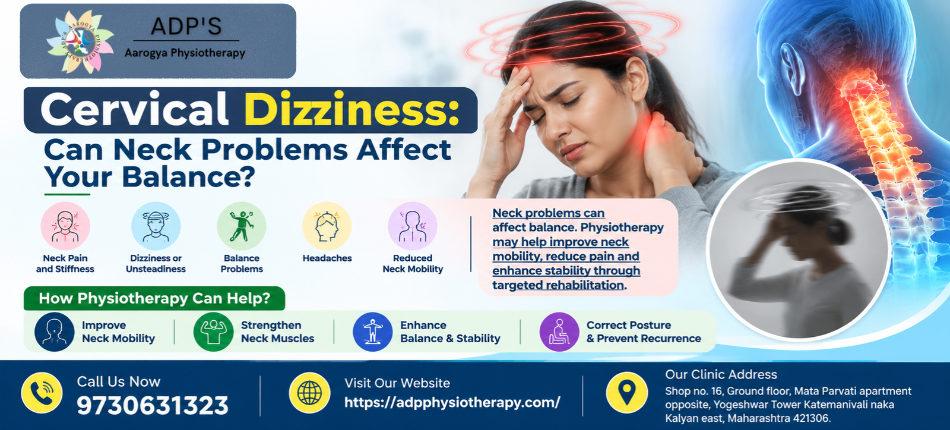
Cervical Dizziness: Can Neck Problems Affect Your Balance? – ADP Physiotherapy
Have you ever felt dizzy, unsteady, or off-balance while turning your head, looking upward, or sitting for long hours? Do you experience neck stiffness along with headaches and a floating sensation? While dizziness is commonly associated with inner ear problems, certain neck-related conditions may also contribute to balance difficulties.
This condition is often described as cervicogenic dizziness, also known as cervical dizziness. It involves dizziness or unsteadiness associated with neck pain, restricted movement, or cervical spine dysfunction.
The neck plays an important role in helping the brain understand head position and movement. When sensory information from the neck does not coordinate properly with signals from the eyes and inner ears, balance difficulties may occur. However, the precise mechanisms remain under investigation, and other causes of dizziness must be evaluated before attributing symptoms to the neck.
Cervicogenic Dizziness Physiotherapy may help selected patients improve neck mobility, muscle control, balance, and everyday movement confidence.
At ADP Physiotherapy in Kalyan East, patients experiencing neck pain, stiffness, and movement-related discomfort can enquire about physiotherapy assessment and rehabilitation.
In this detailed guide, we explain the causes, symptoms, diagnosis, physiotherapy treatment options, exercises, prevention strategies, and recovery considerations for cervical dizziness.
1. What Is Cervicogenic Dizziness?
Cervicogenic dizziness refers to dizziness or a feeling of imbalance that appears to be associated with neck pain or cervical spine dysfunction.
People experiencing this condition may describe sensations such as feeling unsteady, floating, disoriented, or unstable while walking or changing head position.
Unlike some inner ear disorders, cervicogenic dizziness is not typically characterized by intense spinning sensations.
The condition may be associated with neck stiffness, restricted cervical movement, headaches, and discomfort during certain activities.
Importantly, cervicogenic dizziness remains a debated clinical diagnosis because there is no single definitive diagnostic test. Healthcare professionals generally consider it only after evaluating other possible causes of dizziness.
2. How Can Neck Problems Affect Your Balance?
The human balance system relies on coordination between three important sources of sensory information.
The Vestibular System
Located in the inner ear, the vestibular system detects head movement and changes in position.
The Visual System
The eyes provide information about the surrounding environment and help the brain maintain orientation.
The Proprioceptive System
Muscles, joints, and other tissues contain sensory receptors that help the brain understand body position and movement.
The neck contains proprioceptive receptors that contribute information about head position relative to the body.
Researchers have proposed that altered sensory input from painful or dysfunctional cervical structures may interfere with the brain’s integration of balance information.
This could contribute to sensations of unsteadiness or disorientation in some individuals.
However, neck pain and dizziness occurring together do not necessarily prove that the neck is causing the dizziness.
3. Common Causes and Associated Factors of Cervical Dizziness
Several neck-related conditions may be associated with dizziness and balance complaints.
3.1 Cervical Muscle Tension
Tight or painful neck muscles can restrict comfortable movement and may contribute to altered neck-related sensory feedback.
3.2 Whiplash Injuries
Whiplash commonly occurs during sudden acceleration or deceleration, such as a road traffic accident.
Some individuals develop persistent neck pain, restricted movement, and dizziness after such injuries.
3.3 Cervical Joint Dysfunction
Painful or restricted movement of cervical joints may be associated with neck stiffness and movement-related dizziness.
3.4 Cervical Spondylosis
Age-related changes in cervical discs and joints may cause neck discomfort and reduced mobility.
However, cervical spondylosis seen on imaging does not establish that it is the cause of dizziness.
3.5 Prolonged Poor Posture
Extended computer use, forward-head positioning, and limited movement can contribute to neck muscle fatigue and discomfort.
These factors may aggravate neck symptoms, but poor posture alone is not a confirmed diagnosis of cervicogenic dizziness.
3.6 Previous Neck Injuries
Previous trauma may affect cervical movement, muscle control, and neck-related sensory function.
A thorough clinical evaluation is needed to determine whether these factors are relevant to an individual’s symptoms.
4. Common Symptoms of Cervicogenic Dizziness
Symptoms vary from person to person and may overlap with several other medical conditions.
Commonly reported symptoms include:
-
Neck Pain and Stiffness: Discomfort or tightness in the cervical region, sometimes associated with reduced movement.
-
Dizziness During Neck Movement: A sensation of unsteadiness when turning or moving the head.
-
Balance Difficulties: Feeling unstable while walking, standing, or changing positions.
-
Headaches: Headaches occurring alongside neck discomfort.
-
Reduced Neck Mobility: Difficulty turning the head comfortably.
-
Disorientation: A floating or off-balance sensation rather than intense spinning.
-
Occasional Nausea: Some individuals may experience nausea during dizziness episodes.
Symptoms are often considered more suggestive of a neck-related contribution when dizziness occurs alongside neck pain and changes with neck movement.
5. Cervicogenic Dizziness vs Vertigo: What Is the Difference?
Cervicogenic dizziness and vestibular vertigo can produce overlapping symptoms, but they are not the same condition.
| Feature | Cervicogenic Dizziness | Vestibular Vertigo |
|---|---|---|
| Possible origin | Neck-related dysfunction | Inner ear or vestibular pathways |
| Common sensation | Unsteadiness or disorientation | Often spinning or movement sensation |
| Neck pain | Commonly associated | May be absent |
| Triggers | May occur with painful neck movement | Depends on condition; sometimes head-position changes |
| Treatment | Neck rehabilitation after appropriate diagnosis | Condition-specific vestibular treatment |
| Diagnosis | Requires exclusion of other causes | Based on history and vestibular examination |
Benign paroxysmal positional vertigo (BPPV), vestibular migraine, and other inner ear conditions may resemble cervical dizziness.
Therefore, dizziness should not automatically be treated as a cervical spine problem.
6. How Is Cervicogenic Dizziness Diagnosed?
A careful clinical assessment is essential because no single test can conclusively confirm cervicogenic dizziness.
Medical History
The healthcare professional may ask about dizziness onset, neck pain, injuries, medications, headaches, hearing symptoms, and activities that trigger symptoms.
Cervical Spine Assessment
Neck movement, muscle tenderness, posture, and functional limitations may be evaluated when safe.
Balance and Coordination Assessment
Standing balance, walking stability, and coordination may be assessed to understand functional difficulties.
Vestibular Assessment
Appropriate testing may be needed to evaluate inner ear conditions such as BPPV or vestibular dysfunction.
Neurological and Medical Evaluation
Depending on the symptoms, referral for neurological, cardiovascular, visual, or other medical evaluation may be required.
Imaging is not routinely diagnostic of cervicogenic dizziness, although a clinician may recommend investigations when another condition is suspected.
Key point: Cervicogenic dizziness is generally considered a diagnosis of exclusion.
7. How Can Cervicogenic Dizziness Physiotherapy Help?
Cervicogenic Dizziness Physiotherapy focuses on addressing relevant neck dysfunction, movement limitations, and balance difficulties after an appropriate assessment.
Treatment should be individualized according to the patient’s symptoms and clinical findings.
7.1 Gentle Cervical Mobility Exercises
Controlled neck movements may help improve flexibility and reduce movement-related stiffness.
Exercises should remain within a comfortable range and should not provoke severe dizziness or neurological symptoms.
7.2 Neck Muscle Strengthening
Strengthening exercises may improve cervical muscle endurance and support controlled head movements.
Deep neck flexor exercises and other stabilization activities may be included when appropriate.
7.3 Posture and Ergonomic Education
Physiotherapists may recommend workstation adjustments, movement breaks, and strategies to reduce prolonged neck strain.
7.4 Manual Therapy
Selected gentle manual therapy techniques may help reduce neck pain and improve movement in suitable patients.
Forceful neck manipulation is not a routine requirement for dizziness treatment and may be inappropriate when vascular, neurological, or other safety concerns are present.
7.5 Balance Training
Balance exercises may help improve stability during standing, walking, and daily activities.
7.6 Vestibular Rehabilitation
When a vestibular impairment is identified, targeted vestibular exercises may be recommended.
These may involve balance activities, gaze stabilization, or other exercises chosen according to the diagnosis.
Research suggests that appropriately selected neck-directed rehabilitation and manual therapy can improve symptoms in some patients, although treatment responses vary and evidence remains limited in certain areas.
8. Benefits of Physiotherapy for Cervical Dizziness
Physiotherapy may provide several benefits when neck-related dysfunction contributes to dizziness and balance problems.
Improved Neck Mobility: Gentle exercises and appropriate rehabilitation may reduce stiffness and improve comfortable cervical movement.
Reduced Neck Discomfort: Targeted treatment may help relieve muscle tension and musculoskeletal pain.
Better Balance and Stability: Individualized balance exercises may improve coordination and confidence during daily activities.
Improved Muscle Control: Strengthening and movement retraining can support better cervical stability and control.
Improved Daily Function: Reducing pain and movement limitations may make activities such as desk work, walking, and turning the head more comfortable.
Results depend on the underlying diagnosis, severity, and response to rehabilitation.
9. Physiotherapy Exercises for Cervicogenic Dizziness
Exercise selection should be based on a professional assessment, especially when dizziness is persistent or unexplained.
The following are examples of activities that may be included in a rehabilitation program.
9.1 Gentle Neck Rotation
Slowly turn the head within a comfortable, pain-free range.
This may help maintain cervical mobility.
9.2 Chin Tuck Exercises
A gentle chin tuck involves drawing the chin slightly backward while keeping the head level.
This exercise may be used to train cervical muscle control.
9.3 Shoulder Blade Retraction
Gently draw the shoulder blades backward without lifting the shoulders.
This may support upper-back muscle function and posture.
9.4 Supported Balance Exercises
Standing balance exercises may be introduced with a stable support nearby and professional supervision when necessary.
9.5 Eye and Head Coordination Exercises
Selected patients may benefit from controlled gaze or head-position exercises, depending on the assessment findings.
Safety note: These are examples, not a self-treatment prescription. Avoid attempting neck movements that provoke severe dizziness, and do not perform balance exercises alone if you are at risk of falling.
10. Can Poor Posture Cause Dizziness?
Poor posture can contribute to neck pain, muscle fatigue, and reduced comfort during prolonged sitting.
For example, people who work on laptops or smartphones for several hours may develop stiffness in the neck and shoulders.
However, there is insufficient evidence to conclude that poor posture alone directly causes dizziness.
If dizziness occurs alongside neck discomfort, healthcare professionals should investigate other possible explanations before identifying the cervical spine as a contributing factor.
Tips for Better Workstation Comfort
-
Position your monitor at a comfortable viewing height.
-
Keep your shoulders relaxed while typing.
-
Support your back while sitting.
-
Take regular breaks from prolonged sitting.
-
Avoid holding the neck in one position for extended periods.
-
Seek assessment if dizziness continues despite ergonomic adjustments.
11. How Long Does Cervicogenic Dizziness Take to Improve?
Recovery time varies depending on the underlying cause, duration of symptoms, associated neck problems, and treatment response.
Some individuals notice improvement over several weeks of appropriately selected rehabilitation, while others require longer-term management.
People with previous whiplash injuries, persistent neck pain, or multiple causes of dizziness may need a more comprehensive treatment plan.
There is no reliable fixed recovery timeline that applies to everyone.
If symptoms worsen, new neurological signs develop, or treatment produces little improvement, the diagnosis and management plan should be reassessed.
12. When Should You Consult a Physiotherapist for Cervical Dizziness?
Consider seeking professional assessment if you repeatedly experience dizziness associated with neck pain, stiffness, restricted movement, or balance difficulties. Symptoms that interfere with walking, working, driving, or normal daily activities should not be ignored.
A physiotherapist can assess neck mobility and functional limitations and determine whether rehabilitation may be appropriate. However, unexplained or persistent dizziness may require medical evaluation to exclude vestibular, neurological, cardiovascular, or other causes before beginning neck-focused treatment.
Seek emergency medical attention if dizziness occurs suddenly with facial drooping, speech difficulty, new weakness, double vision, inability to walk, or a sudden severe headache.
13. How to Reduce Neck Stiffness and Support Better Balance
Healthy movement habits can support neck comfort and everyday function.
Maintain Regular Physical Activity
Appropriate physical activity can help maintain muscle strength and general mobility.
Avoid Prolonged Static Positions
Change position periodically during desk work or mobile phone use.
Follow a Personalized Exercise Program
Exercises recommended after assessment may help improve movement control and functional confidence.
Improve Your Sleeping Setup
Choose a comfortable pillow and sleeping position that does not place unnecessary strain on the neck.
Manage Stress and Muscle Tension
Relaxation, movement breaks, and comfortable breathing may help reduce muscle tension.
Follow Up When Symptoms Persist
Repeated dizziness should be medically evaluated rather than assumed to be caused by neck stiffness.
14. Why Consider ADP Physiotherapy for Neck Pain and Balance Rehabilitation in Kalyan East?
People experiencing neck pain, restricted movement, and balance-related difficulties may benefit from an individualized physiotherapy assessment.
ADP Physiotherapy in Kalyan East is a local option for people seeking guidance about musculoskeletal rehabilitation, posture-related discomfort, and movement problems.
A suitable treatment approach may involve assessing cervical mobility, muscle function, posture, balance, and the relationship between symptoms and daily activities.
Where neck-related dysfunction is identified and other relevant causes of dizziness have been evaluated, physiotherapy may help improve movement confidence and functional comfort.
For more information about services and consultations, visit ADP Physiotherapy.
ADP Physiotherapy – Contact Details
ADP Physiotherapy, Kalyan East
9730631323
Shop No. 16, Ground Floor, Mata Parvati Apartment, Opposite Yogeshwar Tower, Katemanivali Naka, Kalyan East, Maharashtra – 421306.
Conclusion
Cervicogenic Dizziness Physiotherapy may be helpful for selected patients experiencing neck pain, stiffness, unsteadiness, and movement-related balance difficulties.
The cervical spine contributes sensory information that helps the brain coordinate head position and movement. However, dizziness can arise from many different conditions, including inner ear disorders, migraine, neurological problems, medication effects, and cardiovascular causes.
Accurate diagnosis is therefore essential before assuming that neck dysfunction is responsible.
When appropriate, individualized physiotherapy may help improve cervical mobility, muscle control, balance, and confidence during daily activities.
If you experience persistent neck discomfort with dizziness, seek a professional assessment to understand the underlying cause and suitable treatment options.
For physiotherapy-related enquiries in Kalyan East, visit ADP Physiotherapy or contact 9730631323.
Cervicogenic Dizziness Physiotherapy Cervicogenic Dizziness Physiotherapy Cervicogenic Dizziness Physiotherapy Cervicogenic Dizziness Physiotherapy Cervicogenic Dizziness Physiotherapy Cervicogenic Dizziness Physiotherapy Cervicogenic Dizziness Physiotherapy Cervicogenic Dizziness Physiotherapy Cervicogenic Dizziness Physiotherapy Cervicogenic Dizziness Physiotherapy Cervicogenic Dizziness Physiotherapy Cervicogenic Dizziness Physiotherapy Cervicogenic Dizziness Physiotherapy Cervicogenic Dizziness Physiotherapy Cervicogenic Dizziness Physiotherapy Cervicogenic Dizziness Physiotherapy Cervicogenic Dizziness Physiotherapy Cervicogenic Dizziness Physiotherapy Cervicogenic Dizziness Physiotherapy Cervicogenic Dizziness Physiotherapy Cervicogenic Dizziness Physiotherapy