
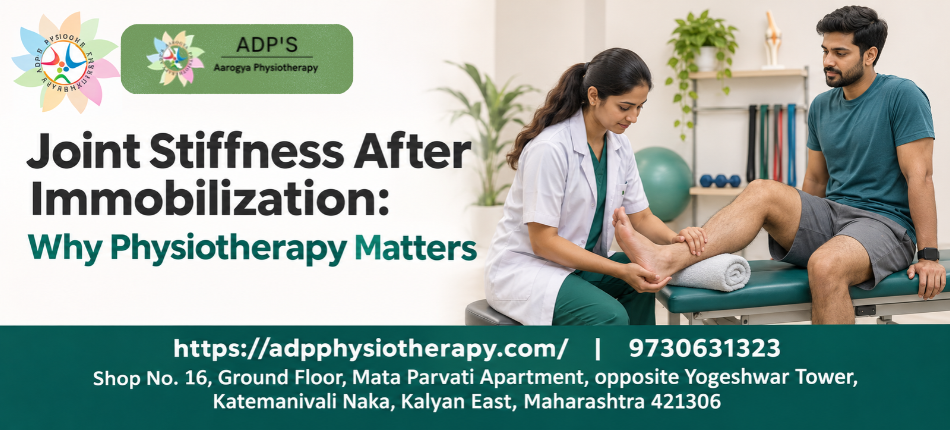
Joint Stiffness After Immobilization: Why Physiotherapy Matters – ADP Physiotherapy
A cast or brace can protect an injury for weeks. When it finally comes off, you may expect to use the limb as before. Instead, your wrist feels tight when you turn a tap, your elbow stops short when you reach for a shelf, or your ankle feels stiff when you go down the stairs. These changes are common after a period of limited movement. How quickly they improve depends on the injury, which movements you’ve been cleared to do, and how the joint responds as you start using it again.
Joint stiffness rehabilitation focuses on getting back the movement and strength you need for everyday activities. For someone with a wrist fracture, that might mean turning a key and carrying groceries. For someone recovering from an ankle fracture, it might mean walking comfortably and managing stairs. At a physiotherapy assessment, those everyday difficulties help guide which movements to work on first. ADP Physiotherapy in Kalyan East
What Is Joint Stiffness After Immobilization?
Immobilization means limiting movement to protect injured or healing tissues. A cast, splint, brace, or walking boot may be used after a fracture, tendon injury, or surgery. While the limb is protected, the joint moves through less of its usual range and the surrounding muscles do less work. After the support comes off, you may notice that the joint feels stiff or sore and the limb tires easily.
Stiffness can show up in one direction more than another. You might be able to bend your elbow far enough to bring a spoon to your mouth but struggle to straighten it when reaching forward. You may walk comfortably across a room yet feel ankle tightness when you try to step down from a kerb. Describing the specific movement or task that feels difficult gives your physiotherapist more information than saying the whole joint feels stiff.
Why Does a Joint Become Stiff After a Cast or Brace?
Several factors can contribute, and more than one can be present at the same time.
- Reduced movement. A joint held in one position gets fewer opportunities to bend, straighten, or rotate. Those movements may initially feel tight when you resume them.
- Swelling and soreness. After injuries such as an ankle fracture, swelling and aching can continue after cast removal and affect how comfortably you move.
- Reduced strength. Muscles that have done less work during recovery can tire sooner when you return to walking, reaching, or gripping.
- Ongoing healing restrictions. Your doctor may allow gentle joint movement while still limiting weight-bearing, lifting, or resisted exercise. Those restrictions shape how you can safely use the limb.
How Physiotherapy Helps Restore Movement After Immobilization
1. The assessment starts with your injury and your daily activities
A physiotherapist can review why the joint was immobilized, how long you wore the support, whether you had surgery, and what your treating doctor has cleared. They can then assess joint movement, swelling, strength, and a task that matters to you. Depending on the injury, that may be walking a short distance, reaching towards a shelf, or turning your palm upwards.
This gives you a starting point for measuring progress. For example, if stiff ankle movement makes it difficult to go downstairs, the assessment can look at how the ankle moves and how you transfer weight onto that leg. If turning a key is difficult after a wrist fracture, the assessment can look at forearm rotation and grip within the limits your doctor has set.
2. Gentle movement helps you regain range of motion
When your treating clinician clears movement, rehabilitation often starts with simple, controlled exercises. Depending on the joint and the injury, these may involve bending and straightening the elbow, moving the ankle up and down, or turning the palm upwards and downwards. Your physiotherapist can show you which movements are appropriate and how far to go.
For example, if forearm rotation is limited after a wrist fracture, the first goal may be to turn your palm far enough to hold a bowl comfortably. As that movement improves, you can measure progress against other activities, such as turning a doorknob or using utensils.
3. Strengthening builds the capacity to use the joint
Regaining movement and regaining strength are related goals. You may be able to move your ankle more freely while seated and still tire quickly when walking. You may bend your wrist more comfortably yet find it difficult to hold a full water bottle.
Once you are cleared for loading, a physiotherapist can gradually build exercises around these demands. For a lower-limb injury, that may involve supported standing, walking practice, and later stair or balance work. For an upper-limb injury, it may involve progressing how much you grip, lift, or carry. Timeline and loading depend on the injury and the treating clinician’s instructions.
4. Gradual practice helps you return to work and everyday routines
The demands of your routine help determine what comes next. A person with a desk job may want to type and use a mouse comfortably. Someone who spends the day standing may need to tolerate longer periods on their feet. A person returning to sport may need to work towards faster changes in direction after they’re cleared for those demands.
Choose a practical milestone with your physiotherapist, such as walking to the local shop, using a flight of stairs, or preparing a meal with less difficulty. If the task becomes easier, that gives you a sign of progress alongside any change in joint range or strength.
What Joint Stiffness Rehabilitation Looks Like in Practice
| Affected joint | Difficulty you may notice | Examples of rehabilitation goals |
|---|---|---|
| Ankle | Stiffness when walking or stepping down | Regain ankle movement, build walking tolerance, and progress to stairs and balance work when cleared |
| Wrist and forearm | Difficulty turning a key, opening a tap, or holding a cup | Improve wrist and forearm movement, then build grip and lifting capacity as healing allows |
| Elbow | Difficulty straightening the arm to reach or bending it to wash your face | Improve bending and straightening within the permitted range, then practise reaching tasks |
| Knee | Difficulty bending the knee to sit down or getting up from a chair | Work on permitted bending and straightening, then progress towards standing and stair use when cleared |
These are examples of goals. Your exercise selection and starting point depend on the injury, any surgery you’ve had, and the instructions from your treating team.
Can You Reduce Stiffness Before the Cast Comes Off?
Depending on the injury, your treating team may encourage movement in nearby joints that the cast leaves free. For example, after some wrist fractures, patients may be advised to move their fingers, elbow, or shoulder while keeping the wrist protected. Ask your fracture clinic or surgeon which movements you can do before the cast comes off, especially if you have specific postoperative restrictions.
Precautions When Starting Physiotherapy After Immobilization
- Confirm your movement and loading limits. Ask what you can bend, rotate, lift, or bear weight through. It helps to know these limits before trying a new exercise.
- Increase activity in steps. Short bouts of approved activity with rests may be easier to manage at first, particularly when returning to walking after an ankle injury.
- Pay attention to changes in symptoms. If an exercise causes sharp pain or a noticeable increase in swelling, pause and contact your treating team for guidance before progressing.
- Seek urgent advice for warning signs while in a cast. Increasing pain with a tight cast, new numbness or tingling, excessive swelling below the cast, or inability to move your fingers or toes needs prompt assessment.
Conclusion
Joint stiffness after immobilization often becomes most noticeable when you try to get back to your usual routine. A joint stiffness rehabilitation plan can help you work from gentle, approved movement towards the strength and control you need for walking, reaching, gripping, or returning to work. The right starting point depends on what has healed, what you’ve been cleared to do, and which tasks are still difficult.
If stiffness or weakness is affecting your daily activities after a cast, brace, or surgery, call ADP Physiotherapy in Kalyan East at 9730631323 to book an assessment. Visit ADP Physiotherapy
Clinic address — Shop No. 16, Ground Floor, Mata Parvati Apartment, opposite Yogeshwar Tower, Katemanivali Naka, Kalyan East, Maharashtra 421306.
Joint Stiffness Rehabilitation Joint Stiffness Rehabilitation Joint Stiffness Rehabilitation Joint Stiffness Rehabilitation Joint Stiffness Rehabilitation Joint Stiffness Rehabilitation Joint Stiffness Rehabilitation Joint Stiffness Rehabilitation Joint Stiffness Rehabilitation Joint Stiffness Rehabilitation Joint Stiffness Rehabilitation Joint Stiffness Rehabilitation Joint Stiffness Rehabilitation Joint Stiffness Rehabilitation Joint Stiffness Rehabilitation Joint Stiffness Rehabilitation Joint Stiffness Rehabilitation Joint Stiffness Rehabilitation