
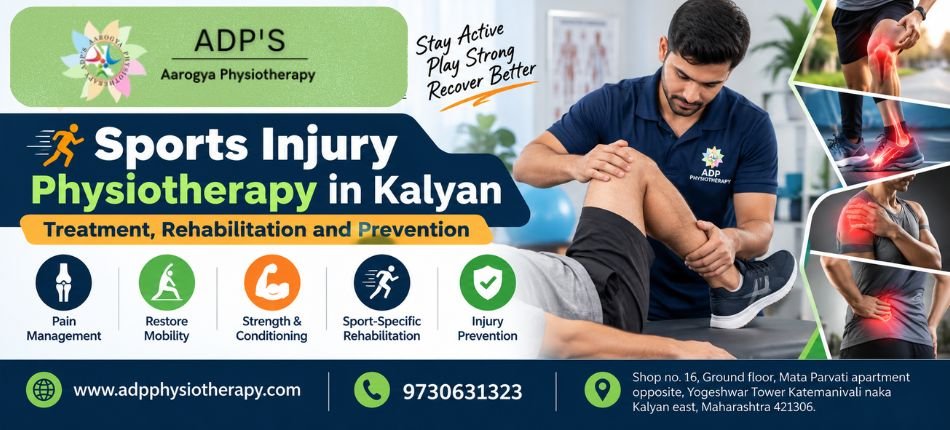
Sports Injury Physiotherapy in Kalyan : Treatment, Rehabilitation and Prevention – ADP Physiotherapy
Introduction
Sports and regular physical activity offer many health benefits, but they can also place significant stress on muscles, joints, tendons, and ligaments. Whether you are a professional athlete, recreational player, gym enthusiast, or someone who exercises regularly, a sports injury can temporarily affect your mobility, performance, and confidence.
Sports injuries can occur suddenly during an activity or develop gradually because of repetitive movements, training errors, or excessive physical load. Appropriate assessment and rehabilitation are important for understanding the injury and planning a safe, progressive return to activity.
Sports Injury Physiotherapy in Kalyan focuses on restoring movement, strength, flexibility, balance, and functional ability following an injury. At ADP Physiotherapy, rehabilitation can be planned according to the type of injury, individual symptoms, activity demands, and recovery goals.
What Is Sports Injury Physiotherapy?
Sports injury physiotherapy is a specialised area of physiotherapy that focuses on the assessment, rehabilitation and prevention of injuries associated with sports, exercise and physical activity.
Treatment does not focus only on the injured area. A physiotherapist may also assess movement patterns, muscle strength, flexibility, balance and the physical demands of the patient’s sport or activity.
The rehabilitation programme is then progressively adjusted according to recovery and functional goals.
What Are the Common Types of Sports Injuries?
Sports injuries can affect almost any part of the body. Some commonly encountered problems include:
- Muscle strains
- Ligament sprains
- Ankle injuries
- Knee injuries
- Shoulder injuries
- Tennis elbow
- Golfer’s elbow
- Hamstring strains
- Groin strains
- Tendon-related problems
- Overuse injuries
- Running-related injuries
- Muscle and joint stiffness
- Sports-related back discomfort
The appropriate treatment depends on the exact injury, its severity, how it occurred and the individual’s overall physical condition.
What Causes Sports Injuries?
Sports injuries may occur due to a single traumatic event or repetitive stress over time. Common contributing factors can include:
Inadequate Warm-Up
Starting intense exercise without sufficient preparation may leave muscles and joints less ready for sudden loads or movements.
Sudden Increase in Training
Rapidly increasing running distance, training intensity, weight or frequency may place more load on tissues than they are accustomed to handling.
Incorrect Technique
Poor technique during running, lifting, jumping or sport-specific movements can increase stress on particular muscles and joints.
Previous Injury
A previous injury may affect strength, mobility or movement patterns, particularly when rehabilitation was incomplete.
Muscle Weakness
Insufficient strength in muscles supporting a joint may affect movement control during demanding activities.
Reduced Flexibility or Mobility
Restricted movement in one region may sometimes lead to compensatory movement elsewhere.
Repetitive Movements
Repeated movements without adequate recovery may contribute to overuse-related symptoms.
How Can Physiotherapy Help With Sports Injuries?
Physiotherapy aims to help an individual regain the physical abilities required for everyday activities and, when appropriate, return to sport.
The rehabilitation process may focus on several areas.
1. Managing Symptoms During the Early Stage
The initial stage of rehabilitation depends on the nature and severity of the injury. A physiotherapist may recommend temporary activity modification and suitable movement strategies.
The aim is to avoid unnecessary aggravation while maintaining safe movement wherever possible.
A sudden severe injury, suspected fracture, dislocation, major swelling or inability to bear weight may require medical assessment before routine rehabilitation begins.
2. Restoring Range of Motion
Sports injuries can sometimes cause stiffness or reduced movement around the affected joint.
Appropriate mobility exercises may be introduced gradually to restore functional range of motion without unnecessarily aggravating symptoms.
The type and intensity of exercises are adjusted according to the injury and stage of recovery.
3. Improving Muscle Strength
Strengthening is an important component of many sports injury rehabilitation programmes.
Exercises may initially be simple and controlled before progressing toward greater resistance and more demanding movements.
The goal is not merely to strengthen the injured area but also to address relevant supporting muscles that contribute to movement and stability.
4. Improving Flexibility
Reduced flexibility may affect movement during certain sports and exercises.
When appropriate, stretching and mobility exercises can be incorporated into rehabilitation to improve functional movement.
Stretching should be selected according to individual needs rather than applying the same routine to every injury.
5. Balance and Proprioception Training
Proprioception refers to the body’s ability to sense joint position and movement.
After certain injuries, particularly ankle and knee injuries, balance and movement-control exercises may form part of rehabilitation.
These exercises can progress from basic standing tasks to more challenging sport-specific activities.
6. Functional and Sport-Specific Rehabilitation
Functional and sport-specific rehabilitation helps prepare the body for the actual movements and physical demands of a particular sport. Depending on the activity, exercises may include running, jumping, landing, agility drills, direction changes, and progressive resistance training. These exercises are introduced gradually according to recovery and functional ability. The aim is to rebuild strength, coordination, movement control, and confidence before returning to regular sports activities.
What Happens During a Sports Physiotherapy Assessment?
During a sports physiotherapy assessment, the physiotherapist evaluates how the injury occurred, current symptoms, previous injuries, training routine, and activity goals. They may assess joint movement, muscle strength, flexibility, balance, and sport-specific movements. This helps identify functional limitations that may be affecting recovery or performance. Based on the findings, an individualised rehabilitation programme can be planned.
Sports Injury Rehabilitation: What Are the Main Stages?
Rehabilitation is usually progressive rather than immediate.
Stage 1: Initial Assessment and Activity Modification
The injury is assessed and activities that significantly aggravate symptoms may temporarily need to be modified.
The objective is to protect the affected area while determining which movements remain appropriate.
Stage 2: Restore Mobility
Once appropriate, controlled movement and mobility exercises can be introduced or progressed.
The goal is to gradually regain the movement required for normal function.
Stage 3: Rebuild Strength
Strengthening exercises become progressively more challenging as recovery advances.
Resistance, repetitions and exercise complexity may be adjusted based on individual progress.
Stage 4: Improve Balance and Movement Control
Balance, coordination and proprioceptive exercises may be introduced depending on the type of injury.
This can be particularly relevant for activities involving rapid movements or changes of direction.
Stage 5: Sport-Specific Training
The patient gradually begins movements that resemble the demands of their sport.
For a runner, this may involve progressive running drills. For another athlete, jumping, agility or directional movements may be more relevant.
Stage 6: Gradual Return to Sport
Return to activity should generally be progressive rather than an immediate return to full training intensity.
The physiotherapist may assess movement, strength, confidence and functional ability before recommending further progression.
Why Is Completing Rehabilitation Important?
A common mistake is stopping rehabilitation as soon as symptoms improve.
Feeling better does not always mean that strength, endurance, balance and sport-specific capacity have fully recovered. Returning to demanding activity before adequate rehabilitation may expose the recovering area to loads it is not yet prepared to manage.
Completing the recommended rehabilitation programme can help rebuild physical capacity and prepare the body for the demands of the chosen activity.
How Can Sports Injuries Be Prevented?
Not every injury can be prevented. However, sensible training and physical preparation may help reduce avoidable risk.
Warm Up Before Activity
A suitable warm-up gradually prepares the body for more demanding movement.
Depending on the sport, this may include light aerobic activity, dynamic movements and activity-specific drills.
Increase Training Gradually
Avoid suddenly increasing training duration, frequency, running distance or resistance.
Gradual progression gives the body time to adapt to increased physical demands.
Include Strength Training
Appropriate strength training can improve the body’s capacity to tolerate physical loads.
Exercises should reflect the individual’s sport, ability and training goals.
Allow Adequate Recovery
Training continuously without sufficient recovery can contribute to fatigue and reduced performance.
Include appropriate recovery according to training intensity and individual needs.
Use Appropriate Technique
Technique matters during running, lifting and sport-specific activities.
Where appropriate, coaching or professional guidance can help identify movement patterns that may need improvement.
Do Not Ignore Persistent Symptoms
Temporary muscle soreness after unfamiliar exercise can occur, but persistent or worsening symptoms should not simply be ignored.
Early assessment can help determine whether activity modification or treatment is needed.
When Should You Consult a Physiotherapist for a Sports Injury?
Consider consulting a physiotherapist if an injury is causing persistent discomfort, stiffness, reduced movement, weakness or difficulty returning to your usual sport or exercise. Recurrent injuries in the same area may also benefit from professional assessment.
You may also seek physiotherapy guidance when returning to activity after a period of injury or inactivity. A structured rehabilitation programme can help progressively rebuild strength, mobility and movement control.
Severe injuries, obvious deformity, significant trauma, inability to bear weight or other concerning symptoms may require prompt medical assessment.
Can Physiotherapy Help With Old Sports Injuries?
An older injury can sometimes continue to affect movement, strength or confidence even after the initial symptoms have settled.
A physiotherapist can assess whether there are ongoing limitations such as reduced mobility, weakness, poor balance or difficulty performing certain movements.
A rehabilitation programme can then focus on the specific functional limitations identified during assessment.
How Long Does Sports Injury Rehabilitation Take?
There is no single recovery timeline for every sports injury.
Recovery can depend on:
- Type of injury
- Severity
- Area affected
- Age and general health
- Previous injuries
- Activity demands
- Consistency with rehabilitation
- Individual healing response
A minor muscle injury and a significant ligament injury, for example, may require very different rehabilitation periods.
Rather than focusing only on a fixed number of days or weeks, rehabilitation should also consider functional progress.
What Is the Difference Between Rest and Rehabilitation?
Rest can be useful during certain stages of an injury, but prolonged inactivity is not automatically the best approach for every sports-related condition.
Rehabilitation involves gradually restoring movement, strength and functional capacity according to the type and stage of injury.
The appropriate balance between protection, activity modification and progressive exercise should be based on individual assessment.
Can You Exercise During Sports Injury Rehabilitation?
In many cases, some form of physical activity may remain possible during rehabilitation, but it may need to be modified.
For example, a physiotherapist may recommend avoiding movements that aggravate the injury while maintaining safe exercises for other areas of the body.
Exercise selection and progression should depend on the injury, symptoms and recovery stage.
Common Mistakes During Sports Injury Recovery
Some habits can interfere with a well-structured rehabilitation process, including:
- Returning to sport too quickly
- Ignoring persistent symptoms
- Stopping exercises immediately after feeling better
- Increasing training load too rapidly
- Performing exercises with poor technique
- Comparing your recovery timeline with someone else’s
- Following random exercises without understanding the injury
- Neglecting strength and balance training
- Skipping warm-ups before returning to activity
A progressive, individualised approach is generally more appropriate than rushing the return to sport.
Conclusion
A sports injury can affect more than your ability to exercise. It may also influence mobility, strength, performance and confidence in returning to activity.
Sports Injury Physiotherapy in Kalyan provides a structured approach to assessment and rehabilitation. Depending on the injury, treatment may focus on restoring mobility, rebuilding strength, improving balance and movement control, and gradually preparing the individual for sport-specific demands.
At ADP Physiotherapy, rehabilitation can be planned according to the individual’s injury, functional limitations and activity goals. Seeking appropriate assessment and following a progressive rehabilitation programme can support a safer and more confident return to exercise and sport.
Sports Injury Physiotherapy in Kalyan Sports Injury Physiotherapy in Kalyan Sports Injury Physiotherapy in Kalyan Sports Injury Physiotherapy in Kalyan Sports Injury Physiotherapy in Kalyan Sports Injury Physiotherapy in Kalyan Sports Injury Physiotherapy in Kalyan Sports Injury Physiotherapy in Kalyan Sports Injury Physiotherapy in Kalyan Sports Injury Physiotherapy in Kalyan Sports Injury Physiotherapy in Kalyan Sports Injury Physiotherapy in Kalyan Sports Injury Physiotherapy in Kalyan Sports Injury Physiotherapy in Kalyan Sports Injury Physiotherapy in Kalyan Sports Injury Physiotherapy in Kalyan Sports Injury Physiotherapy in Kalyan Sports Injury Physiotherapy in Kalyan
Best Physiotherapy Clinic in Ambernath | ADP Physiotherapy Clinic