Gait Retraining: How Physiotherapy Helps Improve Walking Patterns – ADP Physiotherapy
Walking is an essential part of everyday life that allows individuals to maintain independence, perform daily activities, and stay physically active. However, injuries, neurological disorders, muscle weakness, joint problems, and age-related changes can affect natural walking patterns, making movement difficult or uncomfortable.
Gait Retraining Physiotherapy is a specialised rehabilitation approach designed to improve abnormal walking patterns, enhance balance, strengthen muscles, and support better mobility. Individuals experiencing knee pain, joint stiffness, or difficulty walking may also benefit from appropriate Knee Pain Treatment in Kalyan to address underlying joint problems affecting their walking patterns.
At ADP Physiotherapy in Kalyan East, individuals can seek professional assessment and personalised rehabilitation guidance to improve walking mechanics, balance, coordination, and functional mobility.
In this blog, we will explore the common causes of abnormal gait, the benefits of gait retraining, physiotherapy techniques, and how rehabilitation can help individuals achieve safer and more efficient walking patterns.
What Is Gait Retraining Physiotherapy?
Gait refers to the pattern in which a person walks. Normal walking requires coordination between muscles, joints, nerves, balance mechanisms, and the brain. When any of these systems are affected, individuals may develop abnormal walking patterns.
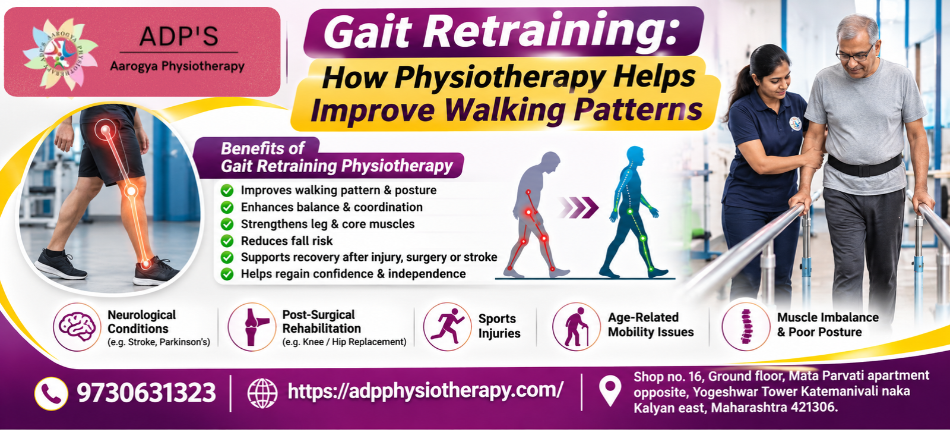
Gait retraining physiotherapy is a specialised rehabilitation approach that focuses on improving walking mechanics, posture, muscle coordination, balance, and functional mobility.
A physiotherapist assesses the underlying cause of walking difficulties and develops an individualised rehabilitation programme based on the patient’s physical condition and mobility goals.
The primary objectives of gait retraining include:
-
Improving walking patterns
-
Enhancing balance and stability
-
Strengthening lower limb muscles
-
Improving body coordination
-
Supporting joint mobility
-
Reducing the risk of falls
-
Promoting functional independence
Common Causes of Abnormal Walking Patterns
Several medical conditions, injuries, and physical limitations can affect the way an individual walks.
1. Muscle Weakness
Weak muscles in the legs, hips, and core can affect stability and walking mechanics. Individuals may experience difficulty maintaining balance, lifting their feet, or distributing body weight evenly while walking.
2. Neurological Disorders
Neurological conditions such as stroke, Parkinson’s disease, cerebral palsy, and multiple sclerosis can interfere with muscle control, balance, and coordination. Physiotherapy may help individuals improve functional movement through condition-specific rehabilitation exercises.
3. Joint Pain and Arthritis
Conditions such as knee arthritis, hip arthritis, and ankle joint problems can cause pain and stiffness during walking. Individuals may develop compensatory walking patterns to reduce pressure on affected joints.
4. Sports Injuries
Ligament injuries, muscle strains, fractures, and ankle sprains can affect normal walking mechanics. Gait rehabilitation can support a gradual return to functional movement following appropriate medical treatment.
5. Post-Surgical Complications
Patients recovering from knee replacement, hip replacement, ligament reconstruction, or fracture surgery may experience temporary difficulty walking due to pain, weakness, swelling, and reduced joint mobility.
6. Poor Posture and Muscle Imbalance
Muscle imbalances and certain postural problems can contribute to inefficient movement and uneven weight distribution. Physiotherapy can help identify and address these issues when they affect walking ability.
7. Age-Related Mobility Problems
Ageing may contribute to reduced muscle strength, joint flexibility, balance, and walking endurance. Older adults may benefit from personalised gait training to maintain mobility and reduce fall risk.
Different Types of Abnormal Gait Patterns
Identifying the type of abnormal gait helps physiotherapists develop appropriate rehabilitation strategies.
| Gait Pattern | Description |
|---|---|
| Antalgic Gait | Walking with reduced weight-bearing time on a painful leg |
| Trendelenburg Gait | Pelvic dropping associated with insufficient hip abductor function |
| Steppage Gait | Excessive lifting of the knee due to difficulty lifting the foot |
| Spastic Gait | Stiff or restricted walking associated with increased muscle tone |
| Ataxic Gait | Unsteady walking with impaired coordination |
| Parkinsonian Gait | Short, shuffling steps, sometimes accompanied by freezing |
| Waddling Gait | Side-to-side body movement, often associated with proximal muscle weakness |
| Hemiplegic Gait | Altered walking pattern associated with weakness on one side of the body |
A professional gait assessment is important because different walking abnormalities may require different treatment approaches.
How Is Gait Analysis Performed in Physiotherapy?
Gait analysis is an assessment method used to evaluate how an individual walks. It helps physiotherapists identify movement abnormalities, muscle weakness, joint restrictions, and compensatory movement patterns.
During a gait assessment, a physiotherapist may evaluate:
-
Walking speed
-
Step length and stride length
-
Foot placement
-
Hip, knee, and ankle movements
-
Body posture and alignment
-
Weight distribution
-
Muscle strength and flexibility
-
Balance and coordination
-
Walking endurance
-
Fall risk
Based on the assessment, the physiotherapist develops a rehabilitation plan that addresses the patient’s specific functional limitations.
How Gait Retraining Physiotherapy Helps Improve Walking Patterns
Physiotherapy combines various therapeutic techniques and functional exercises to support safer and more efficient walking.
1. Muscle Strengthening Exercises
Strengthening exercises target the muscles responsible for walking, particularly the quadriceps, hamstrings, calf muscles, hip muscles, and core. Improving muscle strength can support joint stability, weight-bearing ability, and movement control.
2. Balance and Coordination Training
Balance training helps individuals maintain stability while standing, walking, turning, and performing everyday activities. Physiotherapists may introduce controlled weight-shifting exercises, supported standing activities, and progressively challenging balance tasks according to the patient’s abilities.
3. Posture and Body Alignment Correction
Appropriate body alignment plays an important role in efficient movement. Physiotherapy helps patients recognise potentially inefficient movement habits and develop suitable strategies for maintaining stability while walking.
4. Treadmill-Based Gait Training
Treadmill training may provide a controlled environment for practising repetitive walking movements. With appropriate supervision, patients can work on walking speed, endurance, and coordination. However, treadmill training is not necessarily superior to practising walking on the ground, particularly for ambulatory stroke survivors.
5. Stretching and Flexibility Exercises
Muscle tightness and restricted joint mobility can affect step length and walking comfort. Targeted stretching and mobility exercises may help improve movement where flexibility limitations contribute to gait abnormalities.
6. Functional Walking Exercises
Functional gait training focuses on real-life movements such as walking over different surfaces, changing direction, stepping over obstacles, and climbing stairs. These exercises help individuals develop practical mobility skills required for everyday activities.
7. Assistive Device Training
Some individuals require temporary or long-term support while walking. Physiotherapists can assess whether a walking stick, walker, crutches, or an ankle-foot orthosis may be appropriate and teach patients how to use these aids safely.
8. Neuromuscular Re-Education
Neuromuscular re-education focuses on improving communication between the nervous system and muscles through repeated, task-specific movements. It may help individuals improve movement control, coordination, and functional walking skills following neurological injuries or illnesses.
Clinical rehabilitation guidelines support personalised, repetitive walking practice and progressive functional exercises for improving mobility following stroke.
Common Gait Retraining Exercises
The exercises included in a gait rehabilitation programme depend on the patient’s condition, physical ability, and treatment goals.
| Exercise | Potential Benefit |
|---|---|
| Heel and Toe Raises | Improves ankle strength and control |
| Sit-to-Stand Exercises | Strengthens lower limb muscles |
| Supported Marching | Improves hip movement and coordination |
| Weight-Shifting Exercises | Supports balance and weight-bearing control |
| Step-Up Exercises | Improves functional leg strength |
| Supported Side Walking | Strengthens hip muscles |
| Controlled Walking Practice | Improves walking mechanics |
| Stationary Cycling | Supports lower limb conditioning |
| Ankle Mobility Exercises | Improves ankle movement |
| Supported Balance Exercises | Improves postural stability |
These exercises should be selected by a qualified physiotherapist, especially for individuals with neurological conditions, recent surgery, or a high risk of falling.
Benefits of Gait Retraining Physiotherapy
Gait rehabilitation can offer several functional benefits when treatment is appropriately planned and performed consistently.
-
Improved walking ability and mobility
-
Better balance and coordination
-
Increased lower limb strength
-
Improved joint flexibility
-
Greater walking endurance
-
Reduced unnecessary stress on muscles and joints
-
Improved confidence while walking
-
Reduced fall risk in suitable patients
-
Greater independence in daily activities
-
Support for post-injury and post-surgical recovery
The degree of improvement depends on the underlying condition, severity of impairment, rehabilitation intensity, and individual response to treatment.
Gait Retraining After Stroke
Stroke can affect muscle strength, coordination, balance, and voluntary movement. Many stroke survivors experience difficulty lifting their feet, maintaining balance, or walking independently.
Gait retraining physiotherapy helps stroke survivors practise functional walking movements through progressively challenging exercises. Rehabilitation may include supported walking, balance training, muscle strengthening, rhythmic cueing, and task-specific movement practice.
Research-based stroke rehabilitation guidelines recommend individualised walking exercises to improve walking speed, endurance, and functional mobility.
Gait Retraining After Knee and Hip Replacement Surgery
Patients recovering from knee or hip replacement surgery may initially experience muscle weakness, joint stiffness, discomfort, and difficulty bearing weight.
Physiotherapy plays an important role in supporting postoperative mobility. Gait retraining helps patients gradually improve walking patterns, restore muscle strength, and develop confidence in everyday movements.
Exercises and weight-bearing activities should follow the surgeon’s postoperative instructions to ensure safe rehabilitation.
Gait Retraining Physiotherapy for Senior Citizens
Older adults may experience walking difficulties due to age-related muscle weakness, arthritis, neurological conditions, and reduced balance.
A personalised gait rehabilitation programme can help senior citizens maintain functional mobility, improve stability, and perform daily activities more confidently.
Physiotherapy for elderly individuals may focus on lower limb strengthening, safe walking techniques, balance exercises, fall prevention strategies, and appropriate assistive device training.
How Long Does Gait Retraining Physiotherapy Take?
The duration of gait rehabilitation varies from person to person. Some individuals with minor movement problems may notice improvement within a few weeks, while patients recovering from major injuries, surgery, or neurological conditions may require several months of rehabilitation.
Recovery depends on factors such as age, medical condition, muscle strength, severity of walking impairment, consistency of exercises, and individual treatment goals.
Regular reassessment helps physiotherapists monitor progress and modify the rehabilitation programme when necessary.
Common Mistakes to Avoid During Gait Rehabilitation
Following an appropriate rehabilitation programme is essential for safe and effective recovery.
Common mistakes include practising exercises without professional assessment, ignoring persistent pain, using incorrectly adjusted walking aids, progressing too quickly, discontinuing treatment prematurely, and performing challenging balance exercises without adequate support.
Patients should follow their physiotherapist’s recommendations and communicate any new symptoms or difficulties experienced during rehabilitation.
When Should You Consult a Physiotherapist for Walking Difficulties?
Consider consulting a physiotherapist if you experience persistent limping, difficulty maintaining balance, uneven walking patterns, frequent stumbling, reduced walking endurance, difficulty climbing stairs, or mobility problems following an injury or surgery.
Early assessment can help identify the factors affecting walking ability and establish appropriate rehabilitation goals.
Important: Sudden difficulty walking accompanied by facial drooping, speech difficulties, or weakness on one side of the body may indicate a stroke and requires immediate emergency medical attention.
Why Choose ADP Physiotherapy in Kalyan East for Gait Rehabilitation?
Individuals experiencing walking difficulties can consult ADP Physiotherapy in Kalyan East to understand their rehabilitation needs and explore appropriate physiotherapy options.
A personalised gait rehabilitation programme can focus on identifying movement limitations, improving muscle strength, enhancing balance, and supporting functional independence.
The goal of physiotherapy is not simply to improve walking patterns but also to help individuals perform everyday activities with greater safety, comfort, and confidence.
Frequently Asked Questions (FAQs)
1. What is Gait Retraining Physiotherapy?
Gait retraining physiotherapy is a rehabilitation approach that focuses on improving walking patterns, balance, coordination, muscle strength, and functional mobility.
2. Can physiotherapy correct abnormal walking patterns?
Physiotherapy may improve abnormal walking patterns by addressing muscle weakness, joint restrictions, balance difficulties, and movement control problems. Results depend on the underlying cause.
3. Is gait training helpful after a stroke?
Yes. Gait training is an important component of stroke rehabilitation and may help improve walking speed, balance, endurance, and functional mobility.
4. Can gait retraining reduce knee pain?
Gait retraining may help reduce unnecessary joint stress by addressing certain movement abnormalities. Its effectiveness depends on the cause of knee pain.
5. Is gait rehabilitation suitable for elderly people?
Yes. Personalised gait rehabilitation may help older adults improve balance, maintain mobility, and reduce fall risk.
6. Can gait retraining exercises be performed at home?
Yes. However, home exercises should be recommended by a physiotherapist based on the patient’s physical condition and safety requirements.
7. Is gait training necessary after knee replacement surgery?
Gait training is commonly included in postoperative knee replacement rehabilitation to support walking ability, muscle strength, and functional recovery.
8. Can gait retraining help prevent falls?
Appropriate balance training, strengthening exercises, and walking rehabilitation may help reduce fall risk, particularly when included in a comprehensive fall-prevention programme.
Conclusion
Gait Retraining Physiotherapy plays an important role in improving walking patterns, enhancing balance, strengthening muscles, and supporting functional mobility. Whether walking difficulties arise from neurological conditions, injuries, joint disorders, surgery, or age-related changes, personalised physiotherapy can help individuals work towards safer and more independent movement.
If you are experiencing walking difficulties, balance problems, or reduced mobility, consult ADP Physiotherapy in Kalyan East to discuss appropriate assessment and rehabilitation options.
Take the first step towards improved mobility, better walking confidence, and a healthier, more active lifestyle.
Gait Retraining Physiotherapy Gait Retraining Physiotherapy Gait Retraining Physiotherapy Gait Retraining Physiotherapy Gait Retraining Physiotherapy Gait Retraining Physiotherapy Gait Retraining Physiotherapy Gait Retraining Physiotherapy Gait Retraining Physiotherapy Gait Retraining Physiotherapy Gait Retraining Physiotherapy Gait Retraining Physiotherapy Gait Retraining Physiotherapy Gait Retraining Physiotherapy Gait Retraining Physiotherapy Gait Retraining Physiotherapy Gait Retraining Physiotherapy Gait Retraining Physiotherapy Gait Retraining Physiotherapy Gait Retraining Physiotherapy Gait Retraining Physiotherapy Gait Retraining Physiotherapy Gait Retraining Physiotherapy Gait Retraining Physiotherapy Gait Retraining Physiotherapy Gait Retraining Physiotherapy Gait Retraining Physiotherapy