
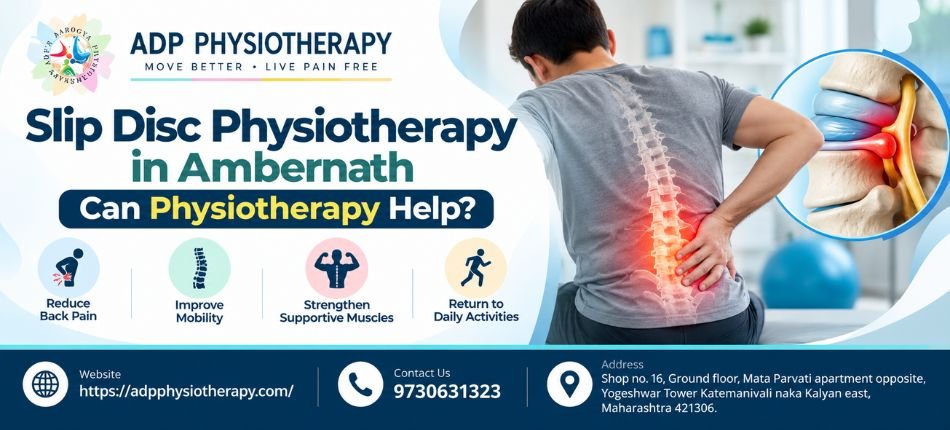
Slip Disc Physiotherapy in Ambernath : Can Physiotherapy Help?- ADP Physiotherapy
Introduction
A slip disc can affect everyday activities such as sitting, standing, bending, walking, working, or exercising. Depending on the location and severity of the problem, some people may experience back or neck discomfort, stiffness, reduced movement, or symptoms that travel into an arm or leg.
For many people, physiotherapy forms part of conservative management. Slip Disc Physiotherapy in Ambernath may focus on improving mobility, strengthening supporting muscles, correcting movement patterns, and gradually helping a person return to normal activities.
At ADP Physiotherapy, treatment is planned according to the individual’s symptoms, physical assessment, functional limitations, and recovery goals rather than relying on the same exercise program for every patient.
What Is a Slip Disc?
The spine consists of individual vertebrae separated by intervertebral discs. These discs act as cushions between the bones and help the spine move while absorbing mechanical stress.
A disc can sometimes bulge or herniate, allowing disc material to affect nearby structures. When a nerve becomes irritated or compressed, symptoms may extend beyond the back or neck into the limbs.
The term “slip disc” is commonly used, although the disc does not literally slip out of place. Depending on the condition, terms such as disc bulge, disc protrusion, or herniated disc may also be used.
What Are the Common Symptoms of a Slip Disc?
Symptoms of a slip disc can vary depending on the location and severity of the condition. A person may experience back or neck discomfort, stiffness, reduced movement, or difficulty with routine activities. In some cases, symptoms may travel into the arms, buttocks, or legs and may include tingling or numbness. If symptoms persist, worsen, or involve weakness, an appropriate medical or physiotherapy assessment is advisable.
What Causes a Slip Disc?
Disc problems can develop due to a combination of age-related changes, repeated mechanical stress, lifestyle factors, or an injury.
Potential contributing factors can include prolonged sitting, repeated bending or lifting, poor lifting technique, reduced physical conditioning, repetitive movements, and age-related degeneration of spinal discs.
However, the presence of a disc abnormality on a scan does not always explain a person’s symptoms. Clinical assessment therefore plays an important role in deciding an appropriate management approach.
Can Physiotherapy Help With a Slip Disc?
Physiotherapy may help many people with symptoms associated with a disc problem, particularly when conservative treatment is considered appropriate.
The purpose of physiotherapy is not simply to focus on the disc itself. Treatment may address mobility, muscle strength, movement tolerance, posture, daily activities, and the individual’s ability to gradually return to normal function.
The exact approach depends on the location of the affected disc, symptoms, neurological findings, severity, general health, and activities the patient wants to resume.
How Does Physiotherapy Help in Slip Disc Recovery?
A physiotherapy program can include several components based on the findings of the assessment.
1. Detailed Physical Assessment
Treatment generally begins with an assessment of symptoms, movement, posture, muscle strength, flexibility, and functional limitations.
The physiotherapist may also consider whether symptoms extend into an arm or leg and whether particular positions or movements make them better or worse.
This information helps determine which exercises and rehabilitation strategies may be suitable.
2. Movement and Mobility Exercises
When movement becomes uncomfortable, people sometimes begin avoiding normal activity. Over time, excessive inactivity can contribute to stiffness and reduced physical capacity.
Appropriate mobility exercises may be introduced gradually to maintain or improve movement. The type and intensity of exercise should be selected according to individual symptoms rather than following a generic routine.
3. Strengthening Exercises
The muscles around the trunk, hips, back, and abdomen contribute to movement and spinal support.
A rehabilitation program may therefore include progressive strengthening exercises. Rather than attempting difficult exercises immediately, the physiotherapist can gradually increase the challenge as the patient’s tolerance and function improve.
4. Posture and Movement Guidance
People who spend long hours sitting, driving, working at a desk, or performing repetitive physical tasks may benefit from guidance on positioning and movement.
Physiotherapy may include advice about sitting, standing, lifting, bending, workstation habits, and changing positions during the day.
The aim is not to maintain one supposedly “perfect” posture continuously, but to encourage comfortable movement and reduce unnecessary strain.
5. Gradual Return to Daily Activities
Recovery is not measured only by symptoms. Being able to perform normal activities is also important.
A physiotherapist may gradually help the patient return to activities such as walking, household work, office work, exercise, or other routine tasks according to their condition and progress.
Is Complete Bed Rest Recommended for a Slip Disc?
Long periods of complete bed rest are generally not the goal of modern rehabilitation for uncomplicated back problems.
A short reduction in aggravating activities may sometimes be necessary, but appropriate movement and gradual activity are often incorporated into recovery when medically suitable.
The amount and type of activity should depend on the individual’s symptoms and clinical findings. Patients should avoid forcing exercises or movements that significantly aggravate their condition.
What Exercises Are Used for a Slip Disc?
There is no single set of exercises that is appropriate for every person with a slip disc.
Depending on the assessment, a physiotherapy program may include:
- Gentle mobility exercises
- Trunk strengthening
- Hip strengthening
- Flexibility exercises
- Movement-control exercises
- Functional exercises
- Progressive walking or activity
- Exercises selected according to symptom response
Exercise selection matters because two people with similar scan findings may have different symptoms and functional limitations.
For this reason, copying exercises from another patient’s program or an online video may not be appropriate.
How Long Does Slip Disc Physiotherapy Take?
There is no fixed recovery period that applies to everyone.
Recovery can depend on factors such as symptom severity, duration of symptoms, neurological involvement, physical condition, activity level, occupation, consistency with rehabilitation, and the underlying diagnosis.
Some people notice functional improvement relatively early, while others may require a longer rehabilitation period.
Regular reassessment helps the physiotherapist modify the program according to progress.
Common Mistakes to Avoid During Slip Disc Recovery
One common mistake is either doing too much too quickly or becoming excessively inactive because of fear of movement.
Other mistakes may include performing unsuitable exercises without assessment, repeatedly lifting heavy loads despite aggravating symptoms, ignoring movement technique, stopping rehabilitation immediately after initial improvement, or expecting one treatment technique to resolve every case.
A gradual, structured approach can make rehabilitation easier to monitor and adjust.
When Should You Seek Medical Attention?
Most back problems are not emergencies, but certain symptoms require prompt medical evaluation.
Seek urgent medical attention if symptoms are associated with new bladder or bowel control problems, numbness around the saddle/genital region, rapidly progressing weakness, significant trauma, or other concerning neurological changes.
People with persistent or worsening symptoms should also obtain an appropriate medical assessment rather than continuing self-treatment indefinitely.
Do All Slip Disc Cases Require Surgery?
No. A diagnosis involving a disc does not automatically mean that surgery is required.
Many people are initially managed using conservative approaches when clinically appropriate. These may include activity modification, medical management, education, and physiotherapy.
However, treatment decisions depend on the individual case. Significant or progressive neurological deficits, certain emergency symptoms, or persistent problems despite appropriate conservative management may require specialist evaluation.
Physiotherapists and doctors can help determine when additional medical assessment is necessary.
Why Choose Individualized Slip Disc Physiotherapy?
Every person with a slip disc may experience different symptoms, movement limitations, and functional difficulties. Individualized slip disc physiotherapy allows the rehabilitation program to be planned according to the patient’s assessment, strength, mobility, daily activities, and recovery goals. Exercises and treatment can then be gradually adjusted according to progress and symptom response. This approach makes rehabilitation more relevant to the patient’s specific functional needs.
Slip Disc Physiotherapy in Ambernath at ADP Physiotherapy
If back or neck symptoms are interfering with your everyday activities, a physiotherapy assessment can help identify movement limitations and determine whether rehabilitation may be appropriate.
At ADP Physiotherapy, Slip Disc Physiotherapy in Ambernath can include assessment, individualized exercise planning, mobility work, strengthening, movement education, and progressive rehabilitation based on the patient’s condition.
Rather than focusing only on temporary symptom management, rehabilitation can also address strength, movement confidence, and return to everyday activities.
Conclusion
A slip disc does not necessarily mean that normal movement and activity must stop. In appropriate cases, physiotherapy can form an important part of conservative rehabilitation by addressing mobility, strength, movement patterns, and functional limitations.
The right treatment plan depends on the individual’s symptoms rather than the diagnosis alone. If you are looking for Slip Disc Physiotherapy in Ambernath, ADP Physiotherapy can assess your condition and develop a rehabilitation program according to your functional needs and recovery goals.
Slip Disc Physiotherapy in Ambernath Slip Disc Physiotherapy in Ambernath Slip Disc Physiotherapy in Ambernath Slip Disc Physiotherapy in Ambernath Slip Disc Physiotherapy in Ambernath Slip Disc Physiotherapy in Ambernath Slip Disc Physiotherapy in Ambernath Slip Disc Physiotherapy in Ambernath Slip Disc Physiotherapy in Ambernath Slip Disc Physiotherapy in Ambernath Slip Disc Physiotherapy in Ambernath Slip Disc Physiotherapy in Ambernath
Best Physiotherapy Clinic in Ambernath | ADP Physiotherapy Clinic