
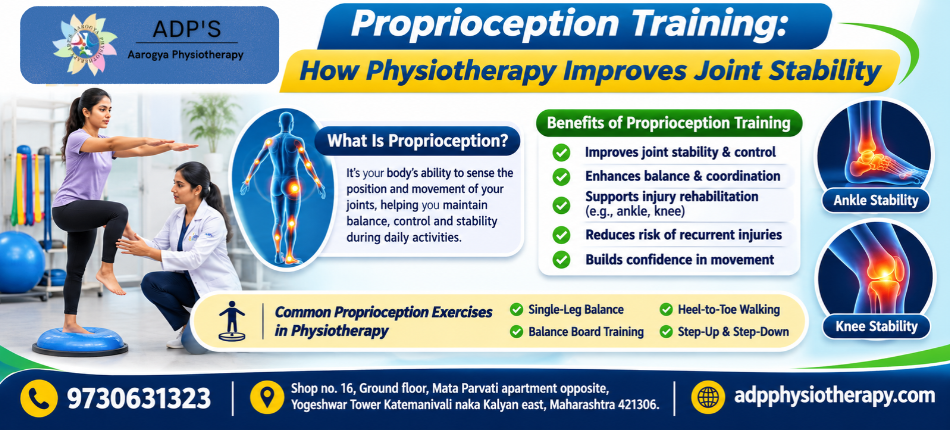
Proprioception Training: How Physiotherapy Improves Joint Stability – ADP Physiotherapy
Introduction
Joint stability is essential for everyday activities such as walking, running, climbing stairs, and maintaining balance. However, injuries, muscle weakness, and poor coordination can affect joint control and increase the risk of falls or repeated injuries. Proprioception Training Physiotherapy is an effective rehabilitation approach that helps improve body awareness, balance, coordination, and joint stability.
Proprioception refers to the body’s ability to sense the position and movement of its joints without looking at them. When this ability is affected by injuries, surgery, or certain medical conditions, individuals may experience joint instability, reduced coordination, and difficulty performing daily activities.
At ADP Physiotherapy in Kalyan East, physiotherapy rehabilitation focuses on improving movement, strength, balance, and functional stability through exercises tailored to individual needs. Proprioception training can be particularly beneficial for people recovering from ankle sprains, knee injuries, sports injuries, and balance-related difficulties.
In this blog, we explore how Proprioception Training Physiotherapy improves joint stability, its benefits, common exercises, and how physiotherapy supports injury recovery and better movement control.
1. What Is Proprioception?
Proprioception is the body’s ability to sense the position, movement, and relative orientation of its joints and limbs.
It helps the brain understand where different body parts are located, even when the eyes are closed.
For example, proprioception allows you to:
-
Walk without looking directly at your feet.
-
Touch your nose with your eyes closed.
-
Maintain balance while standing.
-
Adjust your ankle position on uneven ground.
-
Coordinate movements during sports.
-
Control joint positioning while lifting objects.
How Does Proprioception Work?
Specialized sensory receptors in muscles, tendons, and joints provide information to the nervous system about movement and position.
The brain combines this information with signals from vision and the vestibular system, which contributes to balance.
This coordination helps the body make rapid adjustments during movement.
Why Is Proprioception Important?
Good proprioceptive function contributes to accurate movement, postural control, and effective responses to unexpected changes in body position.
When these functions are impaired, movements may become less controlled, increasing the likelihood of losing balance or placing unwanted stress on joints.
2. What Causes Poor Proprioception?
Several conditions can affect proprioceptive awareness and movement control.
Joint Injuries
Ankle sprains, ligament injuries, and knee injuries can disrupt normal sensory feedback and motor control.
Surgery and Immobilization
Following certain surgeries or periods of immobilization, individuals may experience reduced muscle strength, coordination, and joint-position awareness.
Age-Related Changes
Ageing may affect sensory processing, muscle strength, reaction time, and balance.
Neurological Conditions
Some neurological disorders can interfere with the body’s ability to process sensory information or coordinate movement.
Repeated Joint Instability
Individuals who experience recurrent ankle sprains or episodes of a joint giving way may have persistent deficits in balance and neuromuscular control.
Reduced Physical Activity
Inactivity can contribute to weakness, reduced coordination, and poorer physical performance, although it does not necessarily indicate a specific proprioceptive disorder.
Recognizing the underlying cause is important before beginning a rehabilitation program.
3. Signs You May Need Proprioception Training Physiotherapy
Some people benefit from a physiotherapy assessment when they experience persistent balance difficulties or joint instability.
Common symptoms include:
-
Repeated ankle sprains.
-
Feeling that the knee or ankle may give way.
-
Difficulty balancing on one leg.
-
Unsteadiness on uneven surfaces.
-
Reduced coordination during physical activities.
-
Difficulty returning to sports after an injury.
-
Reduced confidence while walking or climbing stairs.
-
Trouble controlling joint movements during exercise.
These symptoms can have different causes, and not everyone with balance difficulties needs the same type of treatment.
Important: Sudden loss of balance, new weakness, severe dizziness, or difficulty walking may require urgent medical evaluation rather than routine exercise training.
4. How Proprioception Training Physiotherapy Improves Joint Stability
Proprioception Training Physiotherapy uses carefully selected exercises to improve sensory awareness, movement coordination, balance, and neuromuscular control.
Joint stability is not determined by proprioception alone. Ligaments, muscles, tendons, joint anatomy, strength, and nervous-system responses all contribute to stability.
Improves Joint Position Awareness
Exercises help patients practice recognizing and controlling joint positions during different movements.
Enhances Neuromuscular Coordination
Repeated movement tasks can improve coordination between the nervous system and muscles responsible for supporting a joint.
Strengthens Dynamic Stability
Dynamic stability refers to the ability to control joint movement during activities such as walking, squatting, running, or changing direction.
Improves Balance and Postural Control
Balance exercises challenge the body to maintain stability while standing, shifting weight, or moving.
Supports Injury Rehabilitation
Proprioceptive and neuromuscular exercises are frequently included in rehabilitation after ankle sprains, knee ligament injuries, and selected orthopedic procedures.
Builds Confidence in Movement
Gradual exposure to appropriate movement challenges may help patients regain confidence during everyday activities and sports.
The aim is to improve functional control and reduce avoidable instability, not to guarantee that future injuries will never occur.
5. Benefits of Proprioception Training for Joint Stability
Proprioception training offers several potential benefits for people recovering from musculoskeletal injuries or experiencing reduced movement control.
1. Better Balance and Coordination
Balance exercises challenge the body to make controlled adjustments during standing and movement. Regular practice may improve postural stability and coordination.
2. Improved Ankle Stability
After an ankle sprain, patients may experience repeated instability or difficulty balancing. Proprioceptive and neuromuscular exercises are recommended in clinical guidelines for people with chronic ankle instability.
3. Enhanced Knee Joint Control
Proprioception training can be included in knee rehabilitation programs to improve movement control during activities such as walking, squatting, and changing direction.
4. Reduced Risk of Recurrent Injuries
Appropriately designed balance and proprioceptive exercises can help reduce recurrent ankle sprains. Their effectiveness depends on the type of injury and the overall rehabilitation program.
5. Improved Functional Movement
Training may help patients perform everyday activities with better control, including climbing stairs, walking on uneven surfaces, and transitioning between sitting and standing.
6. Greater Confidence During Physical Activity
Progressive rehabilitation may help patients feel more confident when returning to work, exercise, and recreational activities.
6. Common Proprioception Exercises Used in Physiotherapy
Physiotherapists select exercises according to the patient’s condition, injury history, balance ability, and recovery stage.
Single-Leg Balance Training
Standing on one leg challenges ankle and hip control. A physiotherapist may initially recommend holding a stable support before gradually increasing the difficulty.
Balance boards create controlled instability that encourages the body to make continuous postural adjustments. They are generally introduced after basic balance skills are established.
Heel-to-Toe Walking
Also called tandem walking, this exercise challenges coordination by requiring the patient to walk along a narrow line of support.
Controlled stepping activities can improve lower-limb strength, balance, and joint alignment during functional movements.
Foam Pad Balance Training
Standing on a compliant surface changes sensory feedback and challenges postural control. It should be performed with appropriate supervision when fall risk is present.
Other advanced exercises may include controlled reaching, direction changes, hopping, landing practice, and sport-specific movement drills.
Safety note: These examples are educational, not a personalized exercise prescription. Patients with recent surgery, significant instability, dizziness, or a high risk of falling should avoid attempting challenging balance exercises without professional guidance.
7. Proprioception Training for Ankle Injuries
Ankle sprains are among the common injuries that may affect proprioceptive function.
When ankle ligaments are injured, patients may experience pain, swelling, reduced movement, weakness, and altered joint control.
Even after pain improves, some people continue to experience a feeling that the ankle may give way.
How Physiotherapy Helps After an Ankle Sprain
A rehabilitation program may include:
-
Pain and swelling management.
-
Gradual restoration of ankle movement.
-
Strengthening of ankle and lower-leg muscles.
-
Single-leg balance exercises.
-
Dynamic stability training.
-
Walking and functional movement practice.
-
Progressive return to sports or demanding activities.
Clinical guidelines recommend structured rehabilitation, including neuromuscular and balance training, according to injury severity and individual needs.
8. Proprioception Training for Knee Stability
The knee requires coordinated muscle activity and appropriate joint alignment during movement.
After a knee injury, patients may experience weakness, reduced confidence, or difficulty controlling the leg.
Conditions Where Training May Be Considered
-
Anterior cruciate ligament (ACL) injuries.
-
Rehabilitation after selected knee surgeries.
-
Certain ligament injuries.
-
Functional knee instability.
-
Return-to-sport rehabilitation.
Common Knee Stability Exercises
Controlled Mini Squats: Help practice knee alignment and lower-limb control.
Step-Down Training: Challenges knee control during weight-bearing movement.
Single-Leg Standing: Encourages coordination between the ankle, knee, and hip.
Functional Reaching Exercises: Improve control while shifting the body’s center of mass.
Sport-Specific Training: May include direction changes and landing techniques at appropriate rehabilitation stages.
ACL rehabilitation research also discusses the importance of combining physical strengthening with movement-control and neurocognitive exercises.
Patients recovering from surgery must follow their surgeon’s rehabilitation restrictions and physiotherapist’s guidance.
9. Role of Proprioception Training in Sports Injury Rehabilitation
Athletes frequently perform activities requiring rapid movement, balance, coordination, and joint control.
Running, jumping, landing, turning, and changing direction place significant demands on the neuromuscular system.
How Sports Physiotherapy Uses Proprioception Training
Proprioception exercises may be incorporated into:
-
Ankle sprain rehabilitation.
-
Knee ligament rehabilitation.
-
Return-to-running programs.
-
Landing technique training.
-
Agility and direction-change exercises.
-
Injury-prevention programs.
Training is typically progressed from simple, predictable movements to more demanding activities that resemble the athlete’s sport.
A comprehensive injury-prevention program may combine strength, movement technique, balance, and proprioceptive training.
10. Proprioception Training for Older Adults
Balance and movement control are particularly important for older adults because falls can lead to serious injuries.
Age-related changes in muscle strength, sensory function, vision, and reaction time may contribute to balance difficulties.
Potential Benefits
A carefully designed physiotherapy program may help older adults:
-
Improve standing balance.
-
Develop safer walking strategies.
-
Strengthen lower-limb muscles.
-
Practice controlled weight shifting.
-
Improve confidence during daily activities.
-
Reduce fall risk as part of a broader prevention program.
Proprioceptive exercises are usually combined with strength training, functional exercises, and an assessment of other fall-risk factors.
Older adults with significant balance difficulties should undergo a clinical assessment before beginning exercises.
11. Proprioception Training vs Strength Training
Although proprioception and strength training are related, they target different aspects of physical performance.
| Feature | Proprioception Training | Strength Training |
|---|---|---|
| Main Focus | Joint awareness and movement control | Muscle force and capacity |
| Common Exercises | Balance drills, controlled reaching | Squats, resistance exercises |
| Primary Goal | Improve coordination and stability | Improve strength and endurance |
| Rehabilitation Role | Supports functional joint control | Supports physical loading capacity |
| Best Approach | Combined with strengthening when appropriate | Combined with movement-control training |
Both approaches often work best together. Strong muscles help support joints, while neuromuscular and proprioceptive training helps coordinate how those muscles function during movement.
12. What Happens During a Proprioception Physiotherapy Session?
A physiotherapy session generally begins with an assessment of the patient’s condition and functional limitations.
Step 1: Initial Assessment
The physiotherapist may evaluate:
-
Medical and injury history.
-
Joint movement.
-
Muscle strength.
-
Standing balance.
-
Walking pattern.
-
Functional movement control.
-
Pain and instability symptoms.
Step 2: Individualized Exercise Planning
Exercises are selected according to the patient’s needs, recovery stage, and functional goals.
Step 3: Supervised Balance Training
The patient practices appropriate balance and coordination exercises under guidance.
Step 4: Progressive Rehabilitation
As movement control improves, the physiotherapist may increase the complexity of exercises.
Step 5: Progress Monitoring
Balance, strength, mobility, and functional performance may be reassessed to determine whether the program should be modified.
Step 6: Home Exercise Guidance
Suitable home exercises may be recommended to support progress between sessions.
13. How Long Does Proprioception Training Take to Show Results?
The time required to improve balance and joint stability varies between individuals.
Some patients may notice improvements in basic balance tasks over several weeks, while people recovering from significant ligament injuries or surgery may require longer rehabilitation.
Progress depends on:
-
Type and severity of injury.
-
Duration of symptoms.
-
Baseline balance and muscle strength.
-
Age and general health.
-
Consistency with prescribed exercises.
-
Complexity of the patient’s functional goals.
There is no universal number of sessions that guarantees recovery.
A physiotherapist can monitor progress and adjust the rehabilitation program according to the patient’s response.
14. Can Proprioception Training Help Prevent Future Joint Injuries?
Proprioception training can contribute to injury prevention by improving movement control and the body’s ability to respond to balance challenges.
For example, structured balance training has evidence supporting a reduction in recurrent ankle sprains among people with previous ankle injuries.
However, injury prevention is multifactorial.
Muscle strength, fatigue management, appropriate footwear, movement technique, sports demands, and previous injury history also influence injury risk.
Therefore, Proprioception Training Physiotherapy is most effective when incorporated into a comprehensive rehabilitation or injury-prevention program rather than used as an isolated solution.
15. Why Choose ADP Physiotherapy in Kalyan East for Joint Stability Rehabilitation?
When dealing with joint instability, repeated ankle sprains, or balance difficulties, an individualized physiotherapy assessment can help identify the areas requiring rehabilitation.
ADP Physiotherapy in Kalyan East is a local option for patients seeking guidance about physiotherapy, rehabilitation, balance training, and movement-related concerns.
A suitable rehabilitation program may focus on improving muscle strength, joint control, coordination, mobility, and confidence during daily activities.
The specific exercises and treatment approach should depend on the patient’s clinical assessment and functional requirements.
Contact ADP Physiotherapy
ADP Physiotherapy – Kalyan East
Shop No. 16, Mata Parvati Apartment, Opposite Yogeshwar Tower, Katemanivali Naka, Kalyan East, Maharashtra, India
9730631323
16. Frequently Asked Questions About Proprioception Training Physiotherapy
Q1. What is proprioception training in physiotherapy?
Proprioception training involves exercises that challenge joint-position awareness, balance, coordination, and movement control. Physiotherapists use these exercises as part of rehabilitation programs for selected injuries and functional limitations.
Q2. How does proprioception training improve joint stability?
It helps patients practice controlled movement and improve neuromuscular responses during balance and functional tasks. Joint stability also depends on muscle strength, ligaments, and other structural factors.
Q3. Is proprioception training useful after an ankle sprain?
Yes. Balance and proprioceptive exercises are commonly recommended after ankle sprains, especially when patients experience recurrent instability.
Q4. Can proprioception exercises help with knee injuries?
They may be included in rehabilitation for certain knee injuries, including ligament injuries and post-surgical recovery, when appropriate for the patient’s rehabilitation stage.
Q5. Is proprioception training the same as balance training?
Not exactly. Proprioception refers to sensing body and joint position, while balance involves maintaining stability using proprioceptive, visual, vestibular, and muscular systems. Many exercises train these functions together.
Q6. Can older adults benefit from proprioception training?
Yes. Appropriately supervised balance and movement-control exercises may help older adults improve functional stability as part of a comprehensive falls-prevention program.
Q7. How many physiotherapy sessions are needed for proprioception training?
The number of sessions depends on the patient’s condition, injury severity, functional goals, and response to rehabilitation. A physiotherapist can recommend an individualized plan after assessment.
Q8. Can proprioception training prevent sports injuries?
It may help reduce certain injury risks, particularly recurrent ankle sprains, when incorporated into an appropriate exercise program. It cannot eliminate the risk of injury.
Q9. Can proprioception exercises be performed at home?
Some basic exercises may be appropriate at home after assessment and instruction. Challenging exercises should not be attempted without suitable safety precautions, especially by people with significant instability or fall risk.
Q10. Where can I enquire about proprioception training physiotherapy in Kalyan East?
You can contact ADP Physiotherapy in Kalyan East to enquire about physiotherapy assessment and appropriate rehabilitation options.
Conclusion
Proprioception Training Physiotherapy plays an important role in improving joint awareness, balance, coordination, and functional stability.
Whether you are recovering from an ankle sprain, undergoing knee rehabilitation, experiencing joint instability, or working to improve balance, carefully selected exercises can support safer and more confident movement.
Effective rehabilitation involves more than simply strengthening muscles. It also requires improving how the body senses movement and coordinates muscular responses during everyday activities.
At ADP Physiotherapy in Kalyan East, patients can enquire about individualized physiotherapy assessment and rehabilitation options to support joint stability and functional recovery.
Improve Your Balance. Strengthen Your Joints. Move with Confidence.
Proprioception Training Physiotherapy Proprioception Training Physiotherapy Proprioception Training Physiotherapy Proprioception Training Physiotherapy Proprioception Training Physiotherapy Proprioception Training Physiotherapy Proprioception Training Physiotherapy Proprioception Training Physiotherapy Proprioception Training Physiotherapy Proprioception Training Physiotherapy Proprioception Training Physiotherapy Proprioception Training Physiotherapy Proprioception Training Physiotherapy Proprioception Training Physiotherapy Proprioception Training Physiotherapy Proprioception Training Physiotherapy Proprioception Training Physiotherapy Proprioception Training Physiotherapy Proprioception Training Physiotherapy Proprioception Training Physiotherapy Proprioception Training Physiotherapy