
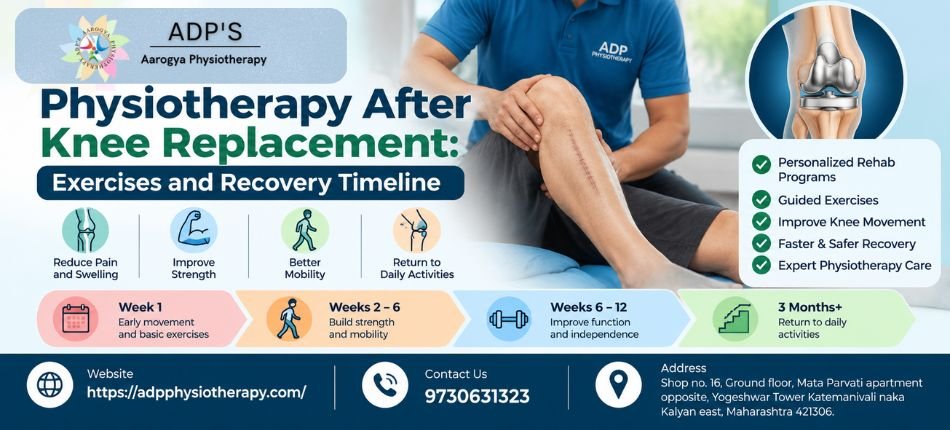
Physiotherapy After Knee Replacement : Exercises and Recovery Timeline – ADP Physiotherapy
Knee replacement surgery can improve mobility and function for people with significant knee joint problems, but surgery is only one part of the recovery process. A structured rehabilitation program is important for restoring knee movement, rebuilding muscle strength, improving walking ability, and gradually returning to everyday activities.
Physiotherapy After Knee Replacement commonly begins soon after surgery, with exercises and activities progressing gradually according to the patient’s condition and medical advice. At ADP Physiotherapy, rehabilitation programs focus on improving mobility, strength, balance, walking patterns, and functional independence based on each patient’s recovery needs.
Because every patient recovers differently, the exercises, intensity, and recovery timeline should be personalized under the guidance of the treating surgeon and physiotherapist.
Why Is Physiotherapy Important After Knee Replacement?
After knee replacement surgery, the muscles surrounding the knee may be weak, while stiffness and reduced mobility can make normal activities challenging. Physiotherapy focuses on gradually restoring movement and helping patients become more independent.
A rehabilitation program may work on knee range of motion, muscle strength, walking pattern, balance and endurance. AAHKS rehabilitation resources similarly emphasize stretching, strengthening, endurance and balance during knee-replacement recovery.
The specific rehabilitation plan depends on factors such as the type of surgery, general health, pre-surgery mobility and individual progress.
When Does Physiotherapy Start After Knee Replacement?
For many patients, movement and basic exercises begin very early after surgery. AAOS notes that patients can often begin exercising the knee within hours after surgery, while physiotherapists help patients start walking and performing basic activities.
Early rehabilitation does not mean doing difficult exercises immediately. Initially, the focus is generally on safe movement, circulation, muscle activation, knee bending and straightening, and learning to walk with appropriate support.
Early Recovery: First Few Days After Surgery
During the first few days, physiotherapy usually focuses on safe mobility and basic exercises. Patients may initially need a walker or crutches while learning to move safely.
Early exercises may include ankle pumps, quadriceps contractions, supported knee bends and knee-straightening exercises. These activities are commonly used to improve circulation, activate muscles and begin restoring knee movement.
The amount of walking and exercise should be determined by the medical and physiotherapy team rather than following a fixed target for every patient.
Important Exercises After Knee Replacement
The exact exercises prescribed depend on the stage of recovery and the patient’s individual condition. Some commonly used rehabilitation exercises include the following.
1. Ankle Pumps
Ankle pumps involve gently moving the foot up and down at the ankle. They are commonly introduced early in rehabilitation and help maintain movement and circulation in the lower leg.
AAOS includes ankle pumps among early post-operative exercises after total knee replacement.
2. Quadriceps Sets
The quadriceps muscles at the front of the thigh are important for knee control, standing and walking.
A quadriceps set involves tightening the thigh muscles while attempting to straighten the knee. It is a basic strengthening exercise frequently used during early rehabilitation.
3. Knee Straightening Exercises
Regaining knee extension—being able to straighten the knee—is an important rehabilitation goal.
Specific exercises may be prescribed to gradually improve extension while activating the muscles surrounding the knee. These should be performed according to the technique demonstrated by the physiotherapist.
4. Heel Slides or Supported Knee Bends
Knee-bending exercises are used to gradually improve flexion and range of motion.
One approach involves sliding the foot toward the body while bending the knee and then slowly straightening the leg again. The movement should remain controlled and follow the limits recommended by the treating team
5. Straight Leg Raises
As strength improves, straight leg raises may be incorporated into rehabilitation.
This exercise activates the thigh muscles while the knee remains straight and can contribute to rebuilding lower-limb strength. Whether and when it is appropriate depends on the patient’s progress.
Walking After Knee Replacement
Walking is an important part of rehabilitation, but patients commonly begin with a walker or crutches.
Physiotherapy can help patients develop a safer, more efficient walking pattern and gradually increase walking distance. As strength and balance improve, the level of walking assistance may be reduced according to professional advice.
Patients should avoid rushing to stop using a walking aid simply because they have reached a particular number of days or weeks after surgery.
Weeks 2–6: Building Strength and Mobility
During weeks 2–6, physiotherapy after knee replacement generally focuses on gradually improving knee movement, muscle strength, and walking ability. Exercises may include knee bending and straightening, quadriceps strengthening, gait training, and gentle balance activities. As mobility improves, patients may become more independent in everyday activities such as walking, standing, and sitting. Exercise intensity should be increased gradually according to individual progress and the physiotherapist’s guidance.
Weeks 6–12: Returning Toward Daily Activities
By this stage, many patients are working toward improved strength, mobility, balance and independence.
Depending on individual progress, rehabilitation may include more advanced strengthening, balance work, step exercises, functional training and stationary cycling when appropriate.
AAOS notes that resistance exercises may commonly begin around 4–6 weeks when appropriate, while stationary cycling can be introduced and progressed as strength and knee mobility improve. These are general examples rather than universal timelines.
12 Weeks and Beyond: Continuing Recovery
Recovery does not necessarily end after three months.
The NHS notes that full recovery after knee replacement may take several months or longer and varies according to factors such as age and general health. nhs.uk
At this stage, rehabilitation may increasingly focus on endurance, strength, balance, comfortable walking and participation in appropriate everyday activities.
Patients should continue following medical advice regarding activities that place higher stress on the replaced knee.
How Long Does Recovery After Knee Replacement Take?
There is no single recovery timeline that applies to everyone.
Some everyday activities may return within the first several weeks, while strength, mobility and overall recovery can continue improving for months. AAOS states that many normal daily activities may resume within roughly 3–6 weeks, whereas the NHS notes that complete recovery can take several months or longer. nhs.uk
Recovery can be influenced by age, overall health, pre-operative mobility, muscle strength, type of knee replacement, rehabilitation participation and individual healing.
What Is Gait Training After Knee Replacement?
Gait training means working on the way a person stands and walks.
After knee replacement, patients may initially walk differently because of weakness, stiffness or previous movement habits. A physiotherapist can work on step pattern, balance, weight transfer and appropriate use of walking aids.
As strength and confidence improve, the goal is to progress toward a smoother and more independent walking pattern.
Why Is Knee Range of Motion Important?
Both bending and straightening the knee are important for everyday activities.
Knee flexion helps with sitting, stairs and other functional movements, while knee extension contributes to standing and efficient walking.
Physiotherapy therefore commonly includes exercises designed to gradually improve both bending and straightening. However, progress varies between individuals, so patients should avoid comparing their range of motion with someone else’s recovery.
Strengthening After Knee Replacement
Knee replacement rehabilitation does not focus only on the knee joint.
The quadriceps, hamstrings, calf, hip and other lower-limb muscles contribute to walking, balance and functional movement. Progressive strengthening can therefore become an important component of rehabilitation.
Resistance and exercise difficulty should be increased gradually according to the physiotherapist’s assessment rather than adding heavy resistance independently.
Balance and Functional Training
As basic movement improves, rehabilitation can increasingly focus on real-world activities.
Functional physiotherapy may involve practising standing, sitting, walking, changing direction, balance and stairs, depending on the patient’s abilities and goals.
These activities help translate improvements in strength and movement into greater independence in everyday life.
Stair Climbing After Knee Replacement
Stair climbing requires strength, balance and sufficient knee movement.
Initially, patients may need a handrail and a step-by-step technique. AAOS recommends using support initially and progressing as strength and mobility improve. Orthoinfo
Your physiotherapist can demonstrate an appropriate technique based on your operated side, walking aid and current strength.
Can You Use a Stationary Bike After Knee Replacement?
Stationary cycling may be incorporated later in rehabilitation because it can support knee mobility and muscle conditioning.
AAOS describes stationary cycling as an activity that can help regain muscle strength and knee mobility and notes that progression should occur as strength improves. Orthoinfo
Do not begin cycling solely according to a generic online timeline. Your surgeon or physiotherapist should confirm when it is suitable for you.
Common Mistakes to Avoid During Knee Replacement Recovery
Patients sometimes try to progress too quickly because they want to return to normal activities as soon as possible. Others may avoid movement because they are worried about the operated knee.
A better approach is gradual, supervised progression.
Common mistakes include doing exercises with incorrect technique, increasing resistance too quickly, stopping prescribed exercises early, comparing recovery with another patient, ignoring walking technique and attempting demanding activities without professional clearance.
Is Swelling Normal During Rehabilitation?
Some swelling can occur during recovery, particularly after increased activity. AAOS notes that pain or swelling can occur following exercise or activity and advises measures such as elevation and appropriately used ice as directed.
However, new, severe or worsening symptoms should not simply be assumed to be a normal part of rehabilitation.
Follow the post-operative instructions provided by your surgical team and contact them if you are concerned about your symptoms.
When Should You Contact Your Medical Team?
Patients should follow the specific warning signs given by their surgeon and hospital.
Seek medical advice promptly if you develop concerning symptoms such as worsening wound problems, fever, increasing redness or swelling, significant new pain, or other symptoms that your surgical team has advised you to watch for.
Exercise should not be pushed through unusual or severe symptoms simply to meet a rehabilitation target.
How Can a Physiotherapist Help During Recovery?
A physiotherapist can assess your current movement, muscle strength, walking pattern, balance and functional ability.
Based on the assessment and the surgeon’s instructions, the rehabilitation program can be progressed appropriately. Exercises can also be modified when a patient is finding a particular movement difficult.
Regular assessment helps ensure that rehabilitation is based on individual progress rather than a generic timeline.
Physiotherapy After Knee Replacement at ADP Physiotherapy
At ADP Physiotherapy, post-operative rehabilitation can focus on restoring knee mobility, improving lower-limb strength, correcting walking patterns, developing balance and gradually returning to functional activities.
The rehabilitation plan can be adjusted according to the stage of recovery, the surgeon’s recommendations and the patient’s individual needs.
The goal of Physiotherapy After Knee Replacement is not simply to complete a list of exercises. It is to help patients progress safely from early movement toward better mobility, strength and independence in everyday activities.
Conclusion
Physiotherapy After Knee Replacement plays an important role in restoring knee movement, rebuilding strength, improving walking and helping patients return to everyday activities. Rehabilitation typically starts with simple movements and gradually progresses toward strengthening, balance, gait training and functional exercises. Orthoinfo
Most importantly, recovery should not be rushed or compared with another patient’s timeline. The appropriate exercises, intensity and progression should be determined by your surgeon and physiotherapist according to your individual recovery.
ADP Physiotherapy
🌐 Website: adpphysiotherapy.com
📞 Contact: 9730631323
📍 Shop No. 16, Ground Floor, Mata Parvati Apartment, Opp. Yogeshwar Tower, Katemanivali Naka, Kalyan East, Maharashtra – 421306
Physiotherapy After Knee Replacement Physiotherapy After Knee Replacement Physiotherapy After Knee Replacement Physiotherapy After Knee Replacement Physiotherapy After Knee Replacement Physiotherapy After Knee Replacement Physiotherapy After Knee Replacement Physiotherapy After Knee Replacement Physiotherapy After Knee Replacement Physiotherapy After Knee Replacement Physiotherapy After Knee Replacement Physiotherapy After Knee Replacement Physiotherapy After Knee Replacement Physiotherapy After Knee Replacement Physiotherapy After Knee Replacement Physiotherapy After Knee Replacement Physiotherapy After Knee Replacement
https://experienced-physiotherapist-in-ambernath/