
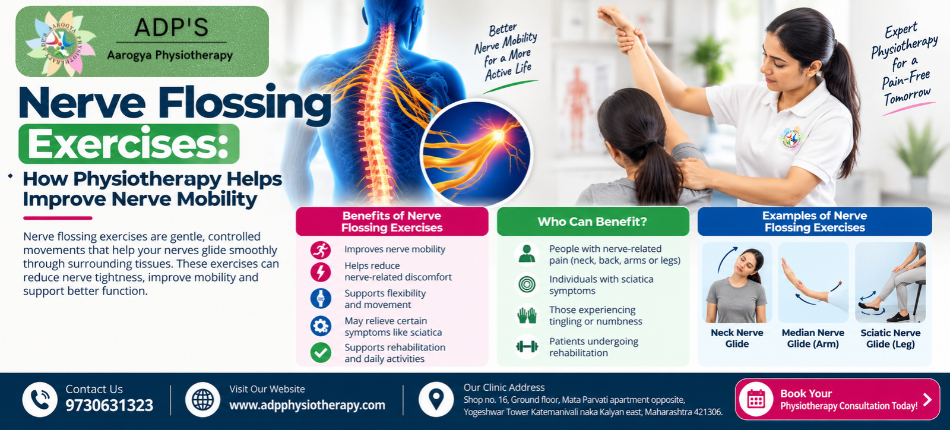
Nerve Flossing Exercises: How Physiotherapy Helps Improve Nerve Mobility – ADP Physiotherapy Clinic
1. Introduction
Do you experience tingling in your hands, numbness in your legs, or a pulling sensation when moving your neck, arms, or lower back? These symptoms may sometimes be associated with nerve irritation or reduced nerve mobility.
Nerves play an essential role in transmitting signals between the brain, spinal cord, muscles, and other parts of the body. During everyday movements, nerves must glide smoothly through surrounding tissues. When this movement becomes sensitive or restricted, certain activities may cause discomfort, tingling, or radiating pain.
Nerve Mobilization Physiotherapy is a specialized physiotherapy approach that uses gentle, controlled movements to help improve nerve mobility and reduce certain nerve-related symptoms. One commonly used technique is known as nerve flossing or nerve gliding.
At ADP Physiotherapy in Kalyan East, patients can seek professional physiotherapy assessment and guidance to understand whether nerve mobilization exercises are suitable for their condition.
In this article, we will explore what nerve flossing exercises are, how they work, their potential benefits, different nerve gliding techniques, and the importance of professional physiotherapy guidance.
2. What Are Nerve Flossing Exercises?
Nerve flossing exercises are gentle movements designed to encourage nerves to glide through the tissues surrounding them. Unlike traditional stretching exercises, which primarily target muscles and tendons, nerve flossing focuses on the movement and mechanical sensitivity of neural structures.
The nervous system includes nerves that travel from the spinal cord through different parts of the body. These nerves pass between muscles, joints, ligaments, and other tissues.
During normal movement, nerves must be able to slide, lengthen slightly, and accommodate changing body positions.
When nerves become irritated or sensitive, certain movements may reproduce symptoms such as:
-
Tingling or pins-and-needles sensations
-
Numbness in the hands or feet
-
Radiating discomfort in the arms or legs
-
Burning or shooting pain
-
Symptoms triggered by specific positions or movements
Nerve flossing exercises aim to promote comfortable neural movement without placing excessive tension on sensitive nerves.
However, these exercises are not suitable for every nerve-related condition. A qualified physiotherapist should first assess the underlying cause of symptoms.
3. What Is Nerve Mobilization Physiotherapy?
Nerve Mobilization Physiotherapy is a rehabilitation technique involving carefully controlled movements of nerves and surrounding structures.
It is sometimes called neural mobilization or neurodynamic treatment.
The technique focuses on improving movement tolerance and addressing symptoms associated with certain nerve-related musculoskeletal conditions.
Nerve mobilization generally includes two approaches.
A. Nerve Sliders
Nerve sliders involve coordinated movements at different joints that encourage a nerve to move while limiting the overall tension placed on it.
These exercises are often selected when a nerve is sensitive to stretching or movement.
Potential benefits include improving movement tolerance and reducing certain nerve-related symptoms.
B. Nerve Tensioners
Nerve tensioners place a controlled amount of mechanical tension on neural structures.
These techniques may be considered during selected stages of rehabilitation when appropriate.
They require careful assessment because excessive tension can aggravate an irritated nerve.
Important: Nerve sliders and tensioners should not be performed interchangeably without professional guidance.
4. How Do Nerve Flossing Exercises Work?
Nerves are surrounded by connective tissues that allow them to move as the body changes position.
For example, when you straighten your knee, bend your neck, or raise your arm, certain nerves must adjust their position relative to nearby muscles and joints.
Nerve flossing exercises use coordinated movements to encourage this natural gliding action.
The proposed therapeutic effects include:
Improving Neural Movement: Gentle movements may help nerves glide more comfortably through surrounding tissues.
Reducing Mechanical Sensitivity: Gradual exposure to controlled movement may improve tolerance to positions that previously caused symptoms.
Supporting Functional Mobility: Improved movement tolerance may help patients participate more comfortably in everyday activities.
Complementing Rehabilitation: Nerve mobilization can be incorporated into a broader physiotherapy program involving strengthening, posture education, and movement retraining.
The effectiveness of nerve flossing varies depending on the condition, symptom severity, and individual response to treatment.
5. Common Conditions Where Nerve Mobilization May Be Considered
Nerve mobilization exercises may be incorporated into physiotherapy programs for certain conditions involving nerve irritation or altered neural movement.
A. Sciatica
Sciatica refers to pain or other symptoms that travel along the distribution of the sciatic nerve, often affecting the lower back, buttock, and leg.
Some patients experience shooting pain, tingling, or numbness that becomes more noticeable during prolonged sitting or specific movements.
A physiotherapist may recommend carefully selected sciatic nerve gliding exercises alongside strengthening, mobility training, and activity modification.
Research suggests that neural mobilization may improve pain and function in some patients with lumbar radicular symptoms, although treatment responses vary.
B. Carpal Tunnel Syndrome
Carpal tunnel syndrome occurs when the median nerve becomes compressed at the wrist.
Common symptoms include numbness, tingling, and discomfort affecting the thumb, index finger, middle finger, and part of the ring finger.
Median nerve gliding exercises may be included in conservative treatment programs for selected patients. Other interventions, such as wrist splinting or medical assessment, may also be necessary.
C. Cervical Radiculopathy
Cervical radiculopathy occurs when a nerve root in the neck becomes irritated or compressed.
Symptoms may include neck pain, radiating arm pain, tingling, or muscle weakness.
Physiotherapy may involve posture education, neck mobility exercises, strengthening, and carefully selected neural mobilization techniques.
D. Peripheral Nerve Irritation
Peripheral nerves can become irritated by compression, repetitive activities, injuries, or certain medical conditions.
Depending on the underlying diagnosis, nerve mobilization may help patients tolerate specific movements more comfortably.
However, symptoms caused by peripheral neuropathy, progressive nerve damage, or systemic disease require appropriate medical assessment rather than relying on nerve flossing alone.
E. Rehabilitation After Certain Injuries
Following some musculoskeletal injuries, patients may experience stiffness, altered movement patterns, or nerve-related discomfort.
Where clinically appropriate, nerve mobilization can be incorporated into rehabilitation alongside strengthening and functional exercises.
6. Different Types of Nerve Flossing Exercises
Different nerve gliding techniques target specific neural structures.
The exercise selected depends on the patient’s symptoms, physical examination findings, and underlying diagnosis.
1. Sciatic Nerve Gliding
The sciatic nerve travels from the lower back through the buttocks and down the legs.
Sciatic nerve gliding exercises involve coordinated movements of the lower limb and, in some variations, the neck or spine.
These movements may be considered for selected patients experiencing radiating leg symptoms.
The exercise should be performed gently, without forcing the leg into a painful stretch.
2. Median Nerve Gliding
The median nerve travels through the arm and wrist into the hand.
Median nerve gliding exercises involve controlled changes in wrist, finger, elbow, and sometimes shoulder positions.
They may be included in rehabilitation for certain median nerve-related conditions, including selected cases of carpal tunnel syndrome.
3. Ulnar Nerve Gliding
The ulnar nerve travels along the inner side of the elbow and supplies parts of the hand.
Irritation of this nerve may cause tingling or numbness in the little finger and part of the ring finger.
Ulnar nerve gliding exercises may be used in selected rehabilitation programs to encourage comfortable neural movement.
4. Radial Nerve Gliding
The radial nerve travels through the upper arm and forearm.
Radial nerve mobilization exercises use carefully coordinated arm, elbow, and wrist movements.
These techniques may be considered when clinical assessment identifies symptoms consistent with radial nerve involvement.
5. Neck-Related Neural Mobilization
Some nerve-related symptoms originate from structures in the cervical spine.
In selected cases, a physiotherapist may use upper-limb neurodynamic exercises alongside neck mobility, postural rehabilitation, and strengthening.
Safety note: These are descriptions of exercise categories, not instructions for unsupervised treatment. Neural exercises performed aggressively can increase symptoms, so technique and intensity should be individualized.
7. Benefits of Nerve Mobilization Physiotherapy
Nerve mobilization may provide several benefits when used for an appropriate clinical indication.
Improved Nerve Movement Tolerance
One objective of nerve mobilization is to help patients become more comfortable with movements involving sensitive neural structures. Carefully selected exercises may improve tolerance to daily activities such as reaching, bending, walking, or changing positions.
Reduced Nerve-Related Discomfort
Some patients with radiating pain or nerve-related symptoms may experience improvements following neural mobilization. A systematic review of lumbar radiculopathy trials found reductions in pain and disability, although the included studies varied considerably in quality and methodology.
Better Functional Mobility
When nerve-related symptoms interfere with movement, physiotherapy may help patients gradually return to comfortable activities. Nerve mobilization can be combined with strengthening and functional training to address broader mobility limitations.
Support for Rehabilitation
Nerve gliding exercises may complement rehabilitation following certain injuries or musculoskeletal conditions. Their role depends on the cause of symptoms, the stage of recovery, and the patient’s response.
Individualized Pain Management
Nerve mobilization is not a universal solution for nerve pain. Its main advantage within physiotherapy is that the technique can be adapted to an individual’s clinical presentation and combined with other evidence-informed interventions.
8. Nerve Flossing vs Traditional Stretching Exercises
Although both approaches involve movement, nerve flossing and traditional stretching have different therapeutic purposes.
| Nerve Flossing Exercises | Traditional Stretching |
|---|---|
| Focus on neural movement and sensitivity | Primarily target muscles and other soft tissues |
| Use coordinated joint movements | Often involve holding or moving into a muscle stretch |
| Aim to encourage comfortable nerve gliding | Aim to improve flexibility and movement tolerance |
| Require attention to nerve-related symptoms | Usually guided by muscle stretch tolerance |
| May be used for selected neural conditions | Commonly used for muscular tightness |
A physiotherapist may recommend both approaches when appropriate.
9. How Physiotherapists Assess Nerve Mobility Problems
Before recommending nerve flossing exercises, a physiotherapist typically performs a detailed assessment.
The physiotherapist may ask about the location of pain, onset of symptoms, tingling, numbness, weakness, previous injuries, and activities that aggravate or relieve discomfort.
Posture and Movement Assessment
Neck, back, shoulder, wrist, and lower-limb movements may be assessed to identify functional limitations or symptom-provoking positions.
Neurological Examination
Depending on the presentation, the examination may include muscle strength, sensation, reflexes, and other neurological findings.
Neurodynamic Testing
Specific movements may be used to evaluate whether symptoms are influenced by mechanical loading of neural structures.
These tests must be interpreted alongside the full clinical assessment. A positive test alone does not establish a diagnosis.
Personalized Rehabilitation Planning
Once the underlying problem is better understood, the physiotherapist may recommend an individualized program involving suitable exercises, strengthening, activity modifications, and progress monitoring.
10. Can Nerve Flossing Exercises Help With Sciatica?
Nerve flossing exercises are sometimes included in physiotherapy programs for people experiencing sciatica or lumbar radicular pain.
Sciatica may occur when nerve roots in the lower back become irritated or compressed. Symptoms can include pain radiating into the buttock or leg, tingling, numbness, and occasionally weakness.
Neural mobilization may help some patients improve movement tolerance and reduce discomfort when combined with appropriate rehabilitation.
A systematic review of eight studies found that adding neural mobilization to conservative treatment improved several outcomes in many of the included trials. However, the researchers emphasized the need for more high-quality evidence.
Sciatic nerve exercises should not be forced into painful positions. Patients with worsening weakness, significant neurological symptoms, or other warning signs need prompt medical evaluation.
11. How Often Should You Perform Nerve Flossing Exercises?
The appropriate frequency depends on the nerve involved, symptom severity, exercise technique, and individual tolerance.
Some rehabilitation programs use short, gentle sessions performed regularly rather than prolonged or forceful stretching.
However, there is no single repetition count or frequency suitable for every patient.
A physiotherapist can recommend:
-
The appropriate nerve gliding technique
-
The number of repetitions and daily sessions
-
The comfortable movement range
-
Whether the exercise should be progressed or modified
-
When to discontinue the exercise
Exercises should not cause persistent worsening of symptoms. Cambridge University Hospitals advises stopping and consulting a physiotherapist if symptoms deteriorate.
12. Common Mistakes to Avoid During Nerve Flossing
Nerve flossing exercises require controlled movements and careful attention to symptoms.
Stretching Too Aggressively: Nerves should not be subjected to forceful stretching. Excessive tension may aggravate irritation or increase symptoms.
Ignoring Pain or Numbness: Increasing pain, persistent tingling, or worsening numbness should not be treated as a normal sign of progress. Stop the exercise and seek professional advice if symptoms worsen.
Performing the Wrong Exercise: Different nerves require different movement patterns. An exercise suitable for one condition may be inappropriate for another.
Doing Too Many Repetitions: Excessive repetitions may increase irritation in sensitive neural structures. Follow an individualized exercise plan.
Relying Only on Nerve Flossing: Nerve-related symptoms can have several causes. Effective management may require medical treatment, strengthening, activity modification, or other interventions.
13. When Should You Consult a Physiotherapist?
Consider a physiotherapy assessment if you experience recurring tingling, radiating discomfort, movement-related nerve symptoms, or difficulty performing normal activities.
A physiotherapist can help determine whether the symptoms are consistent with a musculoskeletal or nerve-related condition and whether nerve mobilization is suitable.
Seek prompt medical assessment for new or progressive muscle weakness, significant loss of sensation, or rapidly worsening neurological symptoms. New bladder or bowel dysfunction, numbness around the groin or saddle area, or severe neurological changes require emergency medical evaluation.
Early assessment helps identify conditions that need medical investigation rather than exercise-based treatment alone.
14. Nerve Mobilization Physiotherapy in Kalyan East – ADP Physiotherapy
If nerve-related discomfort is affecting your daily movements, a professional assessment can help identify suitable rehabilitation options.
ADP Physiotherapy in Kalyan East can be contacted to enquire about physiotherapy assessment and rehabilitation for nerve-related musculoskeletal symptoms.
Depending on clinical findings and the services available, a physiotherapy program may involve nerve gliding exercises, movement retraining, strengthening, posture education, and advice on daily activities.
Nerve mobilization is most useful when selected for an appropriate condition and integrated into an individualized rehabilitation plan.
Conclusion
Nerve Mobilization Physiotherapy is a rehabilitation approach that may help improve movement tolerance and reduce certain nerve-related symptoms when used appropriately.
Nerve flossing exercises involve gentle, coordinated movements intended to encourage neural gliding. They may be considered for selected patients experiencing sciatica, upper-limb nerve irritation, or other musculoskeletal conditions involving neural sensitivity.
However, nerve-related symptoms do not always indicate a problem that can be treated through exercise alone. Accurate assessment, appropriate exercise selection, and professional supervision are important for safe and effective rehabilitation.
If you are experiencing recurring tingling, radiating pain, or difficulty with daily movements, consider a professional physiotherapy evaluation.
Book a Physiotherapy Consultation at ADP Physiotherapy
ADP Physiotherapy – Kalyan East
Contact: 9730631323
Website: adpphysiotherapy.com
Address: Shop No. 16, Ground Floor, Opposite Mata Parvati Apartment, Yogeshwar Tower, Katemanivali Naka, Kalyan East, Maharashtra – 421306
Take a step toward better movement with an individualized physiotherapy assessment.
Nerve Mobilization Physiotherapy Nerve Mobilization Physiotherapy Nerve Mobilization Physiotherapy Nerve Mobilization Physiotherapy Nerve Mobilization Physiotherapy Nerve Mobilization Physiotherapy Nerve Mobilization Physiotherapy Nerve Mobilization Physiotherapy Nerve Mobilization Physiotherapy Nerve Mobilization Physiotherapy Nerve Mobilization Physiotherapy Nerve Mobilization Physiotherapy Nerve Mobilization Physiotherapy Nerve Mobilization Physiotherapy Nerve Mobilization Physiotherapy Nerve Mobilization Physiotherapy Nerve Mobilization Physiotherapy Nerve Mobilization Physiotherapy